
From the Editors Desk- The East Bank of Western Thought
Saturday
morning. They said on the radio that the coastal road is jammed from north to
south. With no political pretensions, yet with many ecological expectations, I
went to visit the
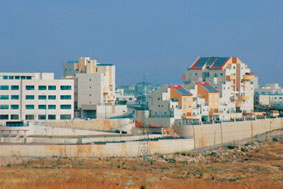
Just after the Rosh Haayin quarries I turned left, heading toward the legendary scenery of the 'territories'. On my left, I spotted the backside of Elad - a religious settlement that sprung up in the absence of any urban planning. If only the planners could be brought to this catastrophic view, I thought, our shrinking state would be spared a wonderful piece of land ruined for the sake of a lost cause. 'How can you be sure we are not missing the border?' asked my mate with increasing anxiety as the sounds of silence became too loud. 'Relax,' I said, reassured by a town of huge military warehouses which crouched safely upon a bulldozer-shaven bedding.
As bad thoughts about 'making the desert bloom' crossed my mind, the scenery sharply switched colors into the ecological, organic and pastoral scenery of the West (I almost forgot of which river) Bank. It was then that the brilliant phrase entered my mind: 'The East Bank of Western Thought.'
A few yards before a checkpoint manned by reservists (who were probably happy to serve the country in a place where others travel to) we parked the car - without having to pay and with no fear of a bullying tow-truck backed by a sadistic traffic warden. A thirty meters walk and we were drowning in a field of cyclamens, anemones and tulips, the kind of which I last saw while roaming the fields surrounding my home town, Zahala, at the age of six. 'Believe it or not,' I explained to my 14 year old daughter, who didnt understand why I had to wake her up as early as 12 noon, 'In these very fields our biblical ancestors dried figs, and milked their goats that grazed on those weeds.' They most certainly did not dream of the hole in the ozone layer, not even as a joke. Nor did they think about bypass roads around olive groves.
Those biblical forefathers must have had something we moderns have never grasped. With the paradox of having to look back in order to march forward, we should reexamine our modern notion of Green Architecture, instead of constantly importing ecological troubles from the wealthy hemisphere.
PS. If you insist on a 'smashing' summation, Id write that the Green Line passes between the wealthy zone and the worthy one.
Dr. Ami Ran

 בניית אתרי אינטרנט