Curiosity- Readers Write
Architect Oren On writes:
'As a long time reader I commend the continuous appearance of the 'House of the Season' column. Your consistency of depicting Israeli houses is awe inspiring. The homes covered over the last few years share a common theme: they are all moderate and lacking fashionable trends (that in our area is often achieved by a shallow eclectic montage), they all deal in some ways with the severe climate, and they all make use of local and natural materials. However, it is surprising that in a state where land is at a premium you depict houses amidst huge lawns, vineyards and orchards. I believe that public housing is an integral part of planning and should also be displayed, even if less sexy and photogenic.'
Thank you Oren. We will be starting a new column for apartment design in the coming issues of Architecture of Israel.
Contributions are welcome.
Architect Simcha Afek comments on 'The Hidden Machine' (issue #56) and emphasizes that the fabulous Crystal Palace built in 1851 by Joseph Paxton, was made of cast iron and not steel as erroneously mentioned.
PRIZES AND COMPETITIONS
The public building and education division of the Municipality of Netanya invited eight architects to compete for the design-concept of a new model for elementary schools. Architects Yoav Messer and Batia Mallul made it to the second stage.
Architect Moshe Zarchi has received an honorable membership to the AIA. During a career spanning over fifty years, Zarchi has planned buildings such as the Hilton Hotel in Tel Aviv (together with Yaacov Rechter), the Zion Archive in Jerusalem, Sheba Medical Center, Rivka Hospital in Zefat, Atidim Industrial Center, School of Dentistry at Tel-Aviv University, and the Center for Atomic Research in Nachal Sorek. Zarchi, who served as vice chairman of the UIA for several years, is the first Israeli to receive this prestigious prize. Congratulations.
The office of Levi-Amir received an honorable mention in an international competition for an archeological park. Fifty proposals participated in the competition held by the UIA. Nice.
The 65,000 NIS David Azrieli prize for young architects will be rewarded starting next year in association with the Architects Association forum of young architects.
The 2004 Builders Union prizes for excellence will be awarded in September, as part of a national competition held for the fourth time.
EVENTS
Architect Al Mansfeld passed away at the age of 92. Mansfeld, who taught for 49 years at the Technion, won the Israel Prize in 1966 for the Israel Museum in Jerusalem. Some of his prominent buildings include Haifa Auditorium, Tikotin Museum, Zim Building, Kibbutz culture centers and dining halls, synagogues and hundreds of residential buildings in Haifa. Born in 1912 in St. Petersburg, Russia, Al Mansfeld studied architecture in Berlin and Paris.
The sixth Jerusalem Seminar in Architecture will be held between May 16th and May 18th. This year the seminar will emphasize material and craft, and will be conducted by British architect Cecil Balmond. Prominent international architects will participate. The seminar will culminate with a student competition for the design of a culture and art center.
The Architects Association objects to the Ministry of Educations decision to abstain, for financial reasons, from this years Venice Biennale. I would normally suggest borrowing funds from the religious parties, but I understand that even they are approaching bankruptcy. The budget necessary is only 300,000 dollars, less than the cost of fuel spent each time Prime Minister Sharon jumps to the US to explain why his disengagement plan is stuck.
'Designing the Community' is an architectural/social initiative by two young architects: Liat Beni-Peled and Shira Barak- Nachmani. The aim is to restore buildings with community significance in southern development towns, by engaging locals, designers, and manufacturers. The first project is Kiryat Malachis public pool, which has been derelict for a number of years.
EXHIBITIONS
The Merrill Berman Propaganda Posters exhibition will run until the end of June. The exhibit contains a collection of Soviet posters by Merrill Berman. The exhibit was brilliantly designed by architect Michael Fieldman. Curator: Alex Ward.
The 'Rashida 2004' exhibition by artist Dani Shoshan was held in the Artists Center in Jerusalem. Apart from a sculpture that was properly placed beneath a skylight, it was difficult to obtain a coherent artistic statement from the various works presented behind aluminum bars. However, leftover pretzels, nuts and drink made a clear cultural statement about Saturday morning show openings.
STUDENTS
Designs in Education Exhibition – outstanding projects by design and architecture students were presented at the Tel-Aviv College of Technology.
Tel-Aviv College provides a non- academic study track in architecture and interior design with a diploma from the Ministry of Labor and Welfare. Program director, architect Bat Sheva Reiss, selected four projects for us:
Student Shachar Srarra designed a 'religious center' at the entrance to Jerusalem; Iris Kolton–Gilliardi designed a 'center for career training' on Shenkin St.; Liron Levy designed a 'paraplane jumping point' on the Netanya promenade; Hagar Manor designed a 'museum strip' along Kikar Hamedina.
Clearly nothing to be ashamed of.
Three students from Bezalel were chosen to display their project at the annual furniture salon in Milan. Yoni Meltz, Noah Halevi and Liran Shemesh designed a futuristic restaurant.
And more from Bezalel: Third year student Adi Asif studied the residential density in Ramat Aviv Gimel. Her conclusion was that the mixture of highrise and lowrise buildings is right. Adi, there is a reason why this neighborhood inspired a television series.
Fourth year students Hagit Baruch and Inbal Raz-Rothbard investigated (separately) the 'good house' and the 'bad house' in private residential building. Hagit defined a 'good house' as a flexible spatial system as opposed to a 'bad house' that is rigid and non-modular. Hagits 'good house' is based on an industrialized system of 'boxes' that can be adjusted to living requirements by tracks and springs. Inbals 'good house' surrounds a cement nucleus for services while the outer layer is flexible and light, and can be changed according to need.
Hagit and Inbal, rigid forms are Modern motifs, while flexibility is a central theme in Post Modern architecture, bad samples of which flood the DIY neighborhoods. Are you for or against?
Bezalel fourth year student Gal Gavriel suggests a project that is both a residential neighborhood and a park. Her module is based on an 'organic rug' topology of horizontal and vertical areas reminiscent of Ebenezer Howards Garden Cities, whose ideals were used to design 'good' cities such as Beer Sheba and Ashdod. Such urban ideas were developed by the Dutch team MVRDV. However, while Holland can tolerate experiments, we only suffer from them.
PROJECTS
Eltha building, Ashdod.
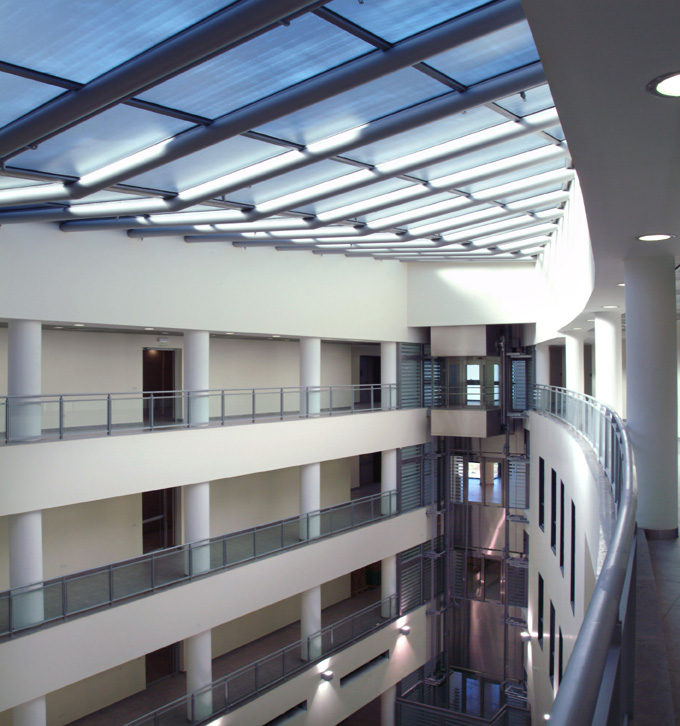
Buildings planned for the defense industry present a problem for architects: the structure can not reflect the function (usually confidential), and the final work is usually hidden from view. In this regard, the Eltha building is ambivalent. On one hand it serves the defense industry, while on the other hand it is a 'visiting card' for world market. The four storey building contains 5500 sqm. that include offices, laboratories, a library, and meeting rooms. The central atrium creates a well lit and amiable working space.
Architects: Doron Tsuf, Eli Silberberg
Thats all for now.
חזרה לגליון 57
back to issue 57


 בניית אתרי אינטרנט