
The New Addition- The Tel Aviv Museum of Art
Most architects are provided with a method or principles that guide their design. Your work is based on what you call "predicaments" - "truths" that generate architecture. Could you review some of them?
"I normally begin by looking for geometric forms that might resolve multiple demands simultaneously. That is, guiding forms which will bring about many solutions. It is the manipulation of these forms that guides my planning process."
Did
the triangular site allotted for the
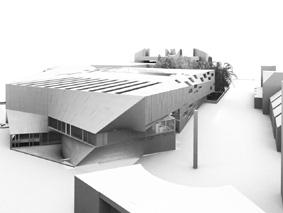
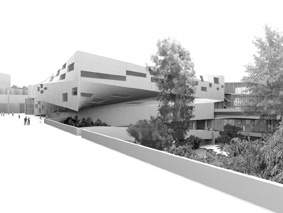
"In the case of the museum I was faced with a triangular site which needed to accommodate large rectangular galleries. At the same time, light needed to be brought to the lower regions of the building. These restrictions exemplify my guiding principle. The search for a geometric solution actually produced a light-well which also engaged the problem of the triangular and rectangular shapes. The light-well makes seamless connections between elements which are otherwise disagreeable. Often the geometric search requires that I invent programmatic solutions. Here, the resolution fits well with the given problem: a series of ruled surfaces which suggest a rotation, also produces a unique architectural event in itself."
How can a geometrically exceptional building meet the expectations of a building meant to serve other forms of art?
"If it is used to develop three dimensional form and not only serve a means to represent architecture. Such projective geometry can give life to a whole new lexicon of forms. It is this exact shift in scale and use of projection, from the development of cutting stonework to the shaping of the entire building, that make it exceptional. In fact, projective geometry is a painterly problem not normally found in architecture. Therefore it can provide yet another reason to break with expectations. It is through projective geometry that one can create elusive spaces - that is, it often creates illusions of perspective that recall amorphous conditions, where an image is distorted according to the location of the subject who is viewing it. This approach destabilizes the taken-for-granted relationship between two dimensional representations of three dimensional forms."
How do you engage the "Site and Context" as a predicament? Can we say that first you search for these resolving shapes, and then the program gets injected into your equation?
"It is a rare occasion that the site is so demanding as to give shape to the building in such an explicit way as in the case of the museum. In many other projects the building finds its shape, or rather I find the shape of the building, long after Ive become involved with the matters of internal organization. I dont normally work from the outside in, and in fact in this case, even though the exterior shape was, in a sense, physically prescribed, I still found a way to work from the inside out. I very much prefer this approach."
Your formal analysis of historic architectural works provides tools for the analysis of difficult scenarios. Can this be seen as upgraded geometric elaborations of Venturis "Contradictory Levels"?
"Yes, in many ways it is related. However, while Venturis emphasis was on perception and interpretation, I pursue a much more explicit dedication to the metrical and geometric basis, though still relying on those known positions of architectural forms. In other words, Venturis approach is much more visual than geometrical or even mathematical."
I have found that one of the most interesting sentences youve written is that "Architecture needs to keep being strange in order not to die off". If we have already accepted Venturis position that "Less is a Bore", why should architects go further and provide "strangeness", and for whom does it need to continue?
"If we accept Venturis motto, indeed architecture must do this. Youre suggesting that having accepted Venturis thesis why would we need to continue the pursuit of "strangeness". It seems to me that if we accept it we must pursue it.
But there is a difference between needing to be "strange" and encouraging decoration...
"I guess the word and concept Venturi alludes to would be ambiguity. When I say strangeness I too am alluding to that in a slightly different way. For example, when I talk about the projection of forms, or the scale of the object, or the perceived distances internal to the object vis-a-vis the viewing subject, "strangeness" has as much to do with those
relationships as it has to do with objective criteria, such as real dimensions, and the mathematics of the object. Those kinds of extensions and associations of form are perhaps more of an interest to Venturi than they are to me. I m more caught up with the internal questions of the geometrical substrates of form. As for why we need to keep proceeding with this? Thats more difficult for me to answer because I dont know why we do anything, for that matter."
Maybe I can guide to a better response through a more general concept. It has been claimed that the Postmodern condition has isolated the pursuit of architecture in general, since it has become so esoteric and important only for architects. Who do you see as the recipient or the receiver of the work?
"Ok, now I see to whom am I speaking of this life or death... Well obviously Im being ambiguous about it because when I speak about the subject in space Im imagining a subject with some awareness of the phenomenon of vision and form. I do not think that some of these conditions I have described are about illusions or mirage.
Overall,
I am not speaking about connoisseurship, but rather about the experience of
space. In that sense architecture remains very much a living experience for
those not necessarily acclimated to the formations of those conditions. The
culture of architecture has to do with the making and interpretation of
buildings, as well as the tactile and haptic
experience of the subject. There are always different audiences, and my
interests are to address many of them simultaneously, and this is what I tried
to produce in the new addition to the

 בניית אתרי אינטרנט