


 79 / 96

2019
פברואר
116
אדריכלות ישראלית
|
קטגוריית מחקר
- 2018-19
תחרות פרויקט השנה
79
|
המשותף, שיועד מלכתחילה להיות מבנה ייצוגי של
אחת המשפחות המשפיעות והעשירות בתקופת
התגבשות המדינה שבדרך .
ויצמן שהתגאה מאוד בתוצאה הסופית נהג
להתפאר במראה הבית ובגניו, תוך ציון העובדה
שמדובר בפרי ידיה של אשתו שדאגה להטביע בו
את חותמה ואת ראיית העולם שלה לגבי נראות
ביתם המשותף, החל מבחירת האתר על הגבעה
בפרדס המוזנח, וכלה בהקמת מכון ויצמן שנבנה
בהמשך סמוך לו.
Between Patroness and Architect:
Vera Weizman's Part in the Design
of Weizman House in Rehovot
Shoshana Harari: Research study for a
Master’s Degree in The History of Art and
Visual Culture – Arts Department, Faculty
of Humanities and Social Sciences, Ben
Gurion University of the Negev.
Tutor: Dr. Sarah Offenberg.
"You’ve built me a modern, beautiful
house, but I cannot live with your design…
I must remind you that it is I who have to
live in the house, not you".
Vera Weizmann, in a letter to architect
Erich Mendelsohn.
The patron/artist relationship touches
on one of the most complex issues in
the architectural profession. In contrast
to any other art work where the creative
aspirations of the artist constitute the main
functional medium, architecture focuses
on the client’s ambition, particularly in
relation to private houses, where a list of
requests express his taste, dreams, social
status and lifestyle.
This research deals with the influence
of Vera Weizmann, wife of Israel's first
President, concerning the visual aspects
of their home in Rehovot, designed
between 1934-1937 by Erich Mendelsohn.
Vera’s impact on the design of Weizmann
House and its internal organization stands
out with regard to Erich Mendelsohn –
who, when designing the house was
already a world-renowned architect with a
recognized and respected style.
Her involvement is also evident in the
north facing garden, where her world view
contradicts that of the prestigious architect
selected to design the house, who strove
to deliver oriental expressions in order to
set the building in the local context.
It is important to note that the President
entrusted all progress in connection
with the architect to Vera (who gave up
her career as a physician for his political
involvement), avoiding any interference in
the design and construction, apart from
matters relating to money.
Vera's most obvious intervention led to
a conflict with Mendelsohn’s minimalist
structure in the rose-garden where guests
were received, the stairs leading to the
entry hall and, actually, the overall interior
look with its abundance of design details,
especially collected items, which for Vera
carried cultural significance.
As a modernist, Mendelsohn strove to
create a functional building that responded
to the surroundings and the climate, using
a design language that included visual
representatives of the environment.
However, Vera’s pressure forced him
to reluctantly accept the flower garden
intended to lengthen the brief Israeli
spring flowering with imported plants.
The colorful blooming suited her romantic
disposition that found expression in a
Western, Edwardian style, adding a
personal touch to the "alien" building,
opposing Mendelsohn’s ambition to imbue
it with an Eastern interpretation.
The interior design on all floors was treated
in the same way, apart from the Eastern
reception room, with colonial collectible
items decorating the first floor, used for
public functions and formal hospitality. In
Vera’s opinion, it gave a colonial touch
to the expression of the family’s cultural
status. Likewise, items imported from
England were placed in the salon, the
dining room and the library.
And thus, the salon became a treasure
chest similar to the European drawing
room, expressing Vera’s world view as an
art collector who later influenced not only
the spatial design of other collectors, but
also other house owners whose homes
had been designed by Mendelsohn, thus
enriching his resume.
Some of Chaim Weizmann’s close circle
viewed Vera’s outspoken intervention as
an intrusion on a formal domain that later
became a battle field when she insisted
that architect and client relationship must
be a two-way dialogue.
A special chapter of the research was
devoted to the subject of financing the
collection, while Vera, daughter of one of
the wealthiest Jewish families in Rostov
(her birth city in White Russia), constitutes
an example of her view point reflecting
wealthy European drawing rooms.
The characteristic design of Vera’s
Habitus in terms of Bourdieu’s theory of
living space, find expression in the villa
that has recently become a museum at
the Weizmann Institute: Her dressing
room, which served as a refreshing
room for visitors before formal meetings,
exhibits personal items belonging to Vera
and Chaim Weizmann, as well as family
photographs that convey the spirit of
the time. Thus, while the political image
of Haim Weizmann - appointed first
State President in 1948 - overshadowed
Vera’s career as a doctor, she stood her
ground with regard to her right to design
everything related to their mutual home.
Weizmann, who was very proud of the
final result, used to praise the appearance
of the house and garden, emphasizing the
fact that it was his wife’s achievement as
she had imbued it with her personal world
view, from the selection of the site in a
neglected orchard, which later became
one of the most influential institutions - the
Weizmann Institute.
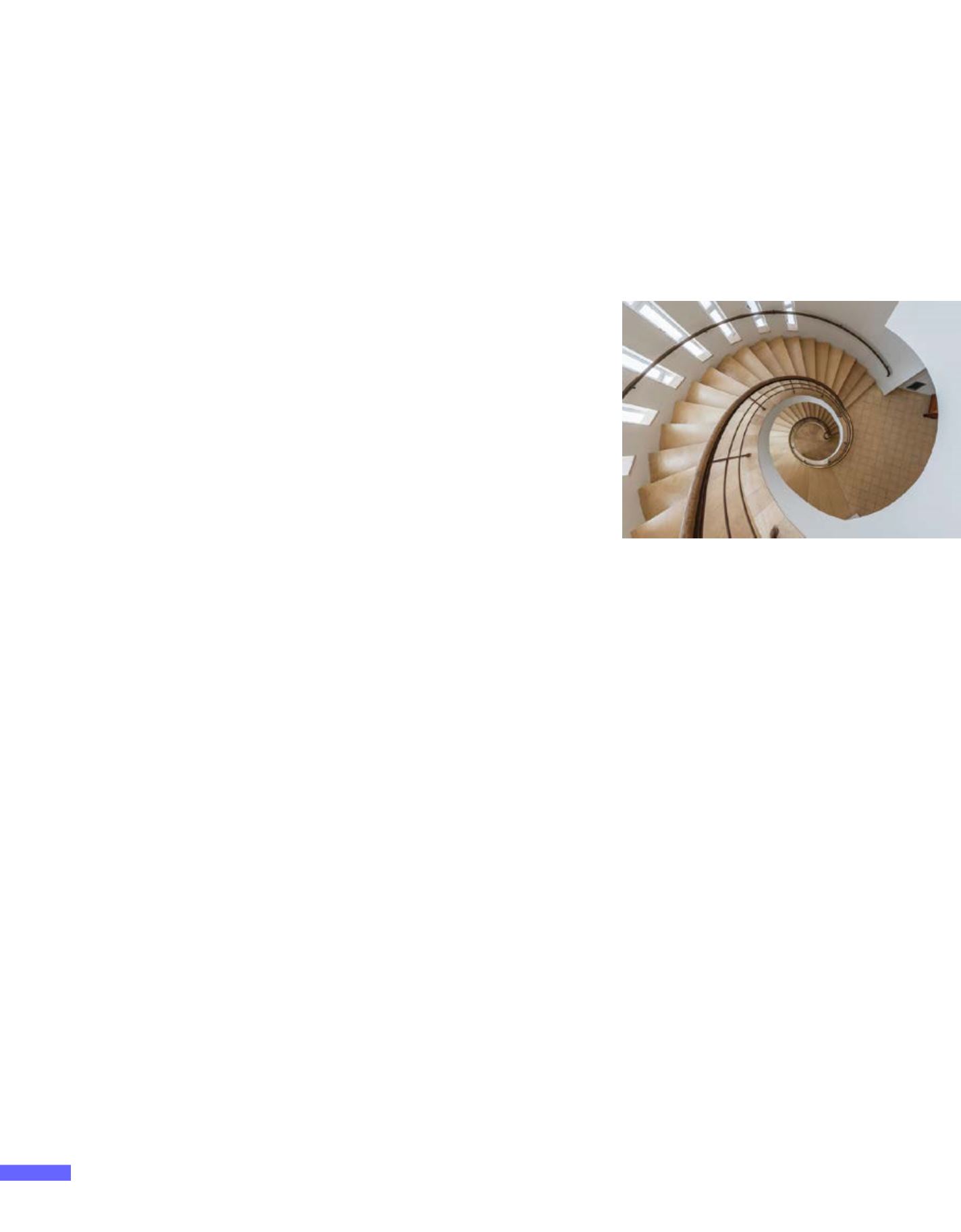
גרם מדרגות אופייני לאריך מנדלסון בווילה
למעלה:
ויצמן, ברחובות.
וילה ויצמן בשולי מכון ויצמן.
בעמוד הימני, למעלה:
הספרייה - שריד להשפעתה של ורה ויצמן
מתחת:
על עיצוב הפנים של וילת ויצמן.
Top:
Erich Mendelsohn's typical staircase in
Villa Weizmann, Rehovot.
Right page, top: Villa Weizmann at the edge
of Weizmann Institute, today.
Below:
The library - a remnant of Vera
Weizmann's influence on the interior design
of Vila Weizmann.