



 77 / 96

2019
פברואר
116
אדריכלות ישראלית
|
קטגוריית מחקר
- 2018-19
תחרות פרויקט השנה
77
|
Development in Marine
Environments
Architect Benjamin Isaac – Chaikin Chair
in Geostrategy, Haifa University,
Chair: Prof. Arnon Sofer.
Israel is one of the most densely populated
countries in the world; approximately 400
residents per sq. kilometer and, north
of Beer Sheva, even exceeding 800
residents per sq. kilometer. However,
since natural growth is rapidly increasing
while availability of construction areas is
limited, housing shortage is only about to
get worse.
In this context the artificial island solution
occasionally resurfaces, particularly in
light of the experience accumulating
throughout the world on the subject,
primarily in countries where the issue of
overcrowding has long existed. Led by
Holland, parts of which are reclaimed,
dried sea areas; Belgium, Singapore,
China, Dubai - who prefer to settle a
marine environment rather than settling
the desert, and Japan - who has learned
to exploit the sea for economic and
industrial needs, as well as the expansion
of industries that support housing areas.
Some of these countries have formed
offshore extensions with breakwaters and
the development of filler materials, which
have become a significant environmental
hazard, creating a conflict between the
purpose and the means required to
achieve it.
The issue of filler materials as a primary
problem was raised by Prof. Micha Bort
at a conference in 1993, devoted to
the subject of artificial islands, using
the experience of the 1960’s achieved
through the Ashdod Port breakwater.
A Dutch-Israeli committee set up in 1999
in order to examine the possibility of
expanding available building areas via
artificial islands, recommended planning
islands in the form of a "drop", assuming
that their expansion would take place
based on the accumulation of experience
and knowledge.
However, the need for importing filling
materials in order to avoid environmental
damage required seeking alternative
technological solutions.
A research study led by Architect
Benjamin Isaac in 2004, developed an
arched, floating breakwater made out of
used containers filled with hyperbolic,
paraboloid metal sheets.
The research recommends the use of
floating platforms as a foundation for
desalination plants, gas runoff and marine
bases, whose development could later
serve as additional architectural solutions
with appropriate statutory provision.
The environmental pollution caused by
the petrochemical industries in Haifa
Bay, and the need to protect the gas rigs
located in the heart of the Mediterranean,
create a perfect opportunity for the
implementation of the research proposal,
combining floating islands adjacent to
the rigs for military purposes. This will
in turn enable further civil developments
near the shore, which might facilitate
regional cooperation with other countries
such as the Palestinian Authority, Jordan,
Lebanon, Egypt and Southern Syria.
The intention is to start the process at
a distance from the shoreline, enabling
the accumulation of experience and
knowledge, later used for urban
development near the shore.
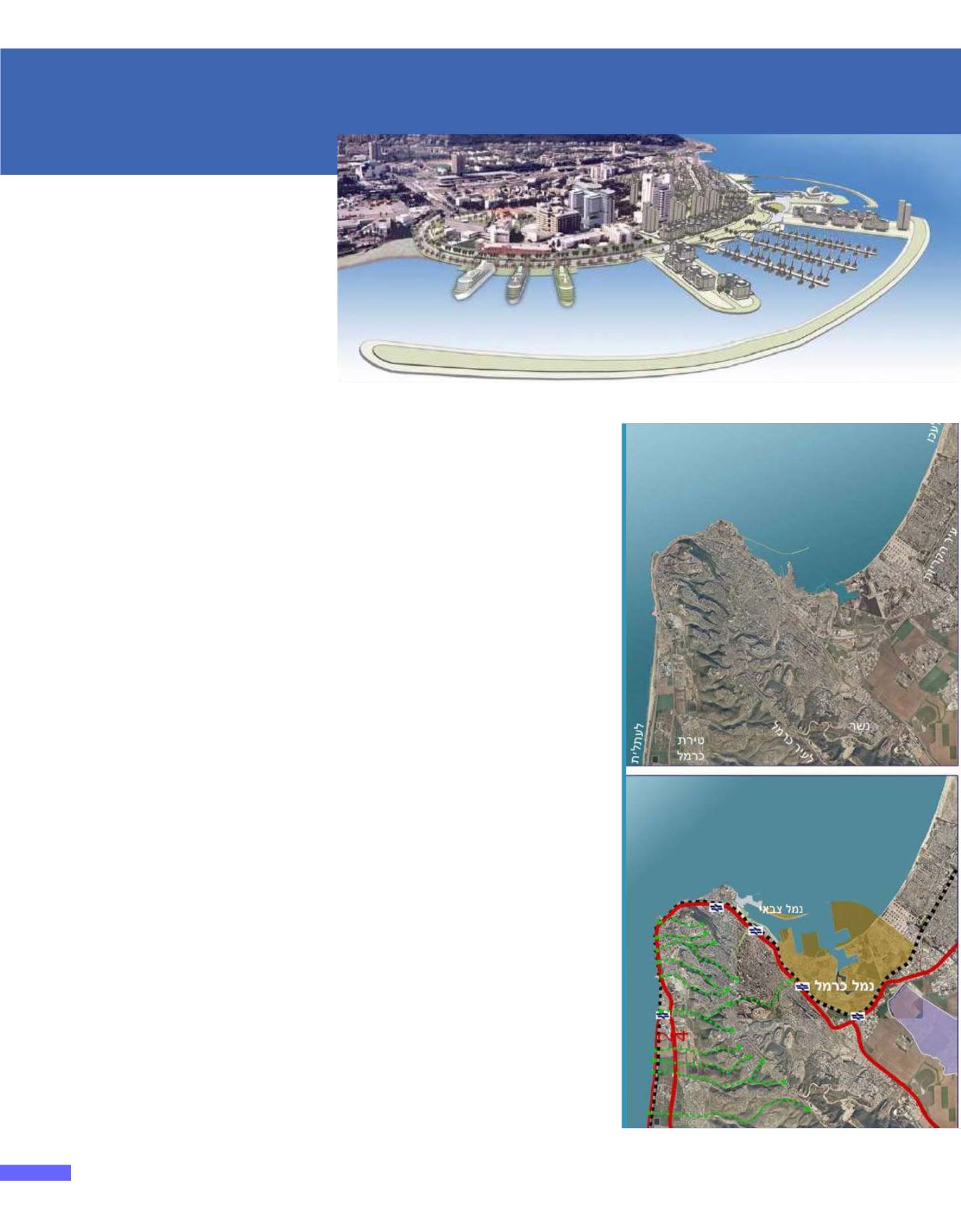
Top:
Proposal for developing of Bat Galim
in Haifa.
Below:
Using artificial islands to improve life
quality in Haifa.
Right page, top:
Semi-floating islands.
Below:
Proposed marine base near the
gas rigs.