


 74 / 96

Architecture of Israel #
117
|
May
2019
|
Hackers & Suckers
page
english readers
Network champions like Amazon and
google have already established huge
delivery warehouses in Israel while
Australia and China allow free delivery
by quadcopters in their territory, which is
likely to reduce the number of scooters
jumping ahead of every second traffic
light just before the light turns green.
Hovering cameras alert and monitor
everything, penetrating the most
concealed places in order to spy,
document and convey information in
real time, bomb, eliminate, and manage
complex systems, until recently viewed
as unattainable. In this reality, traditionally
responsible for spatial order, architecture
requires re-thinking.
Imagine a different world writes Shlomo
Artzi, well, we’re already there, but not
necessarily in better condition, for most
inventions are motivated by marketing
interests, which require counter inventions
- like virus and anti-virus, hacking and
defense, encryption and decoding. But
places like Australia and particularly
China, until recently synonymous with
cheap and bio-degradable products, have
grasped the principle and are applying it
without waiting for any approvedAmerican
standard.
Post officesall over theworldarecollapsing
under the secret missions of the (Abu) ali-
express; millions of people are wasting
about a quarter of their time in traffic jams;
road accidents are now trivialities, billions
of tons of fuel are senselessly burned
up, and global warming will shortly reach
the point of no return - it's about time to
recalculate the route.
Although quadcopters facilitate exciting
selfies from an aerial view, hover over
previously unreachable landscapes,
something to be afraid of
hackers and suckers
in 3D reality
During theearlynineties', anewconcept was introduced toour fickle wish list - Teleportation,
meaning a sudden disappearance from one place in order to re-appear somewhere else.
But the ability to transfer ourselves from one place to another by pressing SEND is still in
the distant future. Well… on second thoughts… maybe not that far. Quadcopters, robots
and bots bring this possibility closer in leaps and bounds.
enabling a better understanding of the
nature of things, the exploring of theoretical
assumptions for developing new theories,
and it won’t take long for quadcopters to
replace mosquitoes and flies (on the wall)
in private rooms, managing both chaotic
systems and voyeurism, eliminating what
is left of privacy.
For this purpose, airports are being
established for more efficient and better
control of random assignments. In this
area, too, the Chinese are pioneers,
managing to erect a building in the same
time it takes us to design one, and the
cities there (in contrast to here) are
scrupulously run, taking on additional
dimensions, almost like Archigram's
3D City in Peter Cook’s vision from the
1960's.
Important developments in this field adopt
the knowledge learned from military
drones, primarily by air force veterans
(at least three Brigadier Generals) who
have already established commercial
companies, managing to persuade the
Ashdod Municipality to pioneer the field
of drones in Israel, convincing them
that within a few years, most public
commercial services will be implemented
by quadcopters.
The main problem with a quadcopter
is its limited flight range, distance from
the operator and, in terms of safety – its
complete dependence on the propellers,
and weather conditions. A most tangible
example was recently demonstrated by
the Israeli spaceship that got all the way
to the moon, but failed to carry out a soft
landing.
The ambition to fly or disappear did not,
of course, begin with Amazon, Google
or SpaceIL, there is evidence in Elijah’s
chariots of fire that flew him to the sky
and, later on, in the second century, in
Lucian the Syrian’s Book, Vera Historia.
Then there was Leonardo da Vinci with
his extraordinary inventions - a flying
machine, tanks, machine guns, diving
suits and a layered, futuristic city with
advanced waste-removal systems and
hydraulic sewage systems.
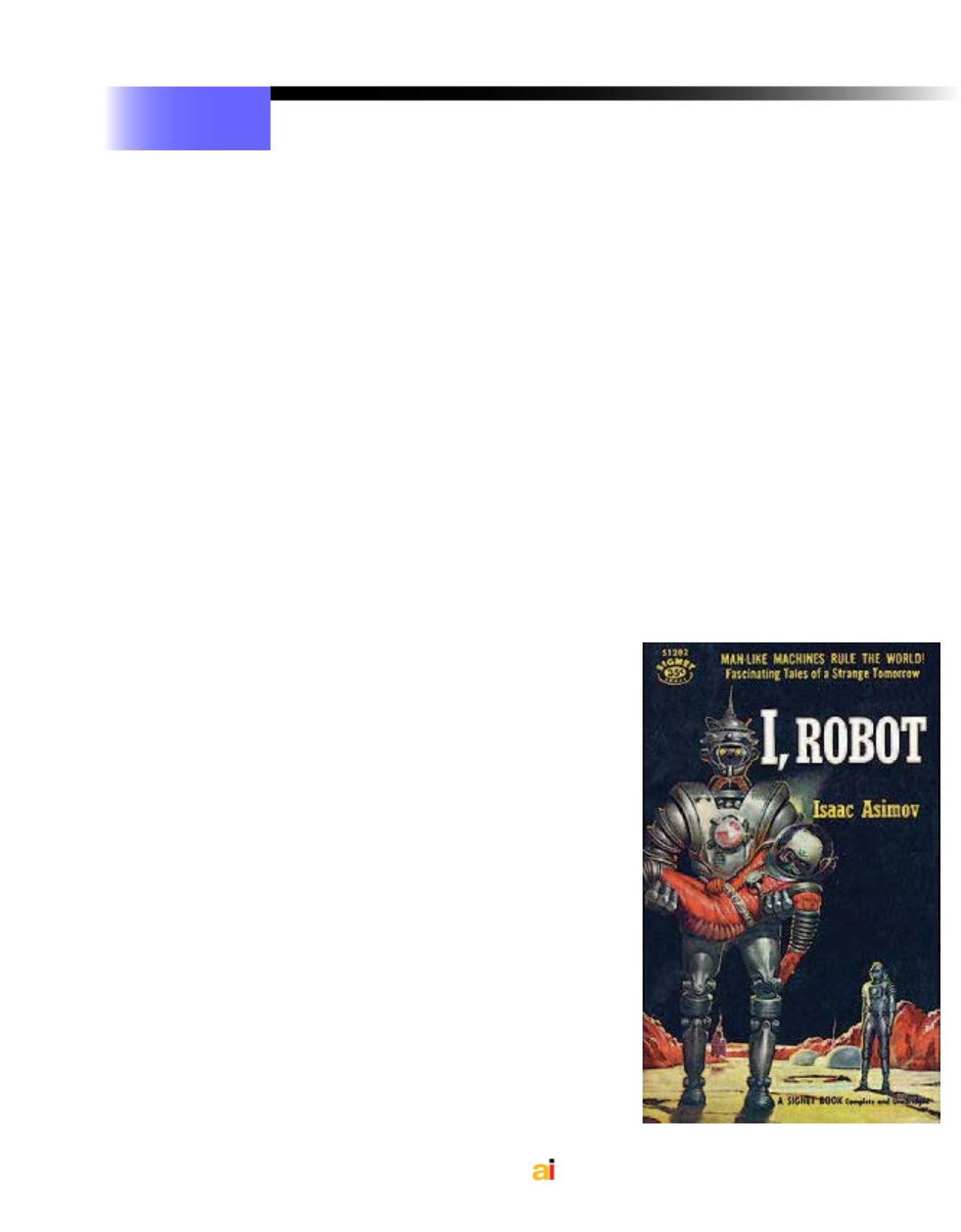
של סופר המדע
"I'Robot"
: עטיפת הספר
למטה
הבידיוני איזאק אזסימוב, שבו פורסמו לראשונה
שלושת כללי האתיקה הרובוטית.
79