


 73 / 96

2019
מאי
117
אדריכלות ישראלית
|
בין רחפנים ומרחפים
73
|
Today it is clear that the speculative
literature known as science fiction –
as opposed to fantasy – has been a
motivating force in everything related
to scientific development, such as the
invention of robots, space exploration,
research of the past, the future, brain
research, behavioral research, and the
research of a vision that has successfully
manifested in IMac, I-Digital, IPhone, and,
lately, I-Parcel, becoming an integral part
of our daily routine.
Since the world operates in three arenas
– safety, security, and control, one must
assume that the most difficult problem
constitutes limiting the freedomof aproduct
whose greatest advantage is (ostensibly)
freedom of movement, yet, its greatest
danger is loss of control over aerial space,
and, as a result, over sovereignty, privacy,
and spatial organization - traditionally the
role of architecture.
Hence, the threats to architecture’s ability
to provide privacy (its very essence)
were the aircraft developed at the end
of the nineteenth century (1887), first via
balloonsmade of flexiblematerials (rubber,
paper, etc.) and, at the beginning of the
twentieth century, with hard materials
like that of the Zeppelin developed
by Count Friedrich von Zeppelin in
Friedrichshafen (Germany), based on the
earlier development of Jewish inventor
(naturally), David Schwartz.
By the way, in Purim, of 1929, the German
Graf-Zeppelin flew over Tel Aviv without
any interference, to the sound of cheering
from those celebrating below, with some
of its Jewish passengers reading Psalms
and throwing down messages to the
audience. And if this is not enough, two
years later, another Zeppelin flew over
Jerusalem, a routine matter then, but one
that today would be perceived as the end
of the world.
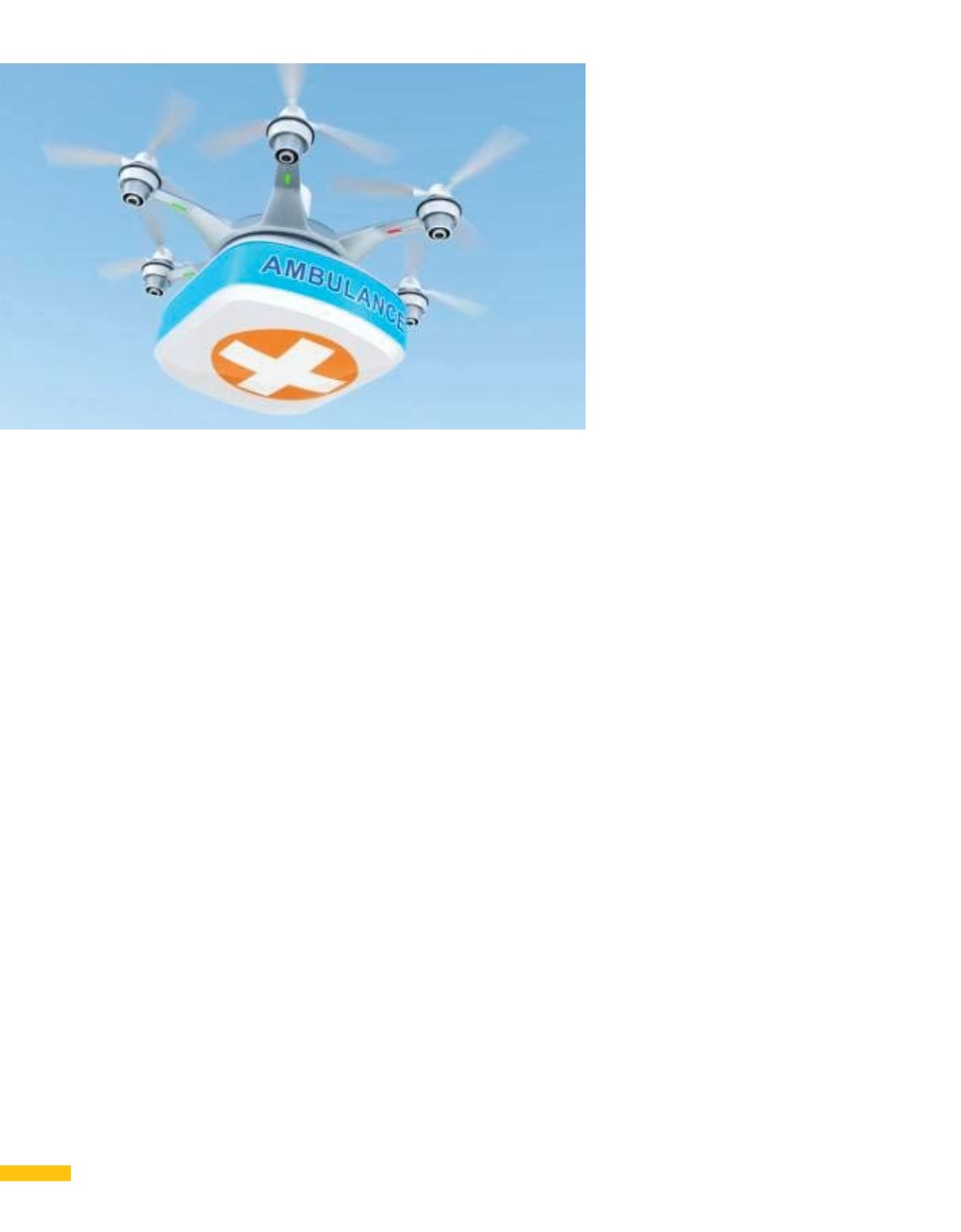
Quadcopter developers today strive to
manage and coordinate all urban systems
via an algorithm – a new pen name for
artificial intelligence openly or covertly
controlled by Big Brother. And to make the
picture more attractive and user friendly,
they add robots that walk in an amusing
way, climb the steps, and knock on the
door to deliver flowers or pizza.
And this isn’t new either. Science fiction
has dealt with robots for centuries, and
even set rules to limit their ability. Famous
among these was the book "Three Laws
of Robotics" published in 1950 by science
fiction writer, Isaac Asimov under the title
"I, Robot". The first law states that Robots
must not injure human beings; the second
– a Robot must always obey human
instructions, unless they contradict the
first law; and the third – a Robot must
protect its existence, unless it conflicts
with the first and second law.
To return to the subject of being able
to convey oneself from one place to
another by clicking SEND – theories
developed since the 1980’s have tried to
explain the correlation between Quantum
Physics and Einstein’s "General Theory
of Relativity" based on Plato’s theory
whereby the material world is merely a
reflection of the world of ideas. The idea
is that every particle of the real world is
represented simultaneously in several
places, like sound waves that represent
a vibrating chord. The importance of all
these ideas is that one can think "outside
the box" while remaining inside the box -
that is - within the same paradigm.
The main problemwith all these inventions
is that they contradict Asimov’s third law,
it will sooner or later be impossible to
control them. And the story about a single
quadcopter that paralyzed London’s
International Airport for two days, speaks
for itself.
A no less fictitious field is that of "artificial
intelligence" (AI#77) which is starting to
jeopardize human ethics. Various high-
tech entrepreneurs are attempting to
compare the digital brain with human
intelligence, producing "fake news" and
fake profiles used by decision-makers.
However, thank God, Man still holds
the keys and all he has to do in order to
prevent a situation whereby "a computer
suddenly gets up one morning, decides
it’s a nation, and starts walking…" is pull
out the plug. After all, robots can tell jokes,
but they can’t understand them.
The correlation between knowledge
and control is traditionally based on the
relationships between decision-makers
and decision implementers: officers and
soldiers; doctors and nurses; architects
and technicians; Cohens and Gabais;
Priests and choirboys; and Rabbis who
control believers through the secrets of
the heavenly world and commandments
they impose on the nation.
In recent decades, the Cyber World has
entered the arena, shortening the way to
the world of knowledge, narrowing the gap
between hackers and (sucker) computer
users.
Australia has recently allowed the use
of quadcopters for food deliveries. It
isn't difficult to imagine the results of the
experiment, when one company attempts
to disrupt communication with competing
companies, and the basket of products
falls on the neighbor's lawn.
Whether hackers or suckers, we shall
continue to fantasize about a world in
which there are no traffic jams, when
the State concludes that it is far cheaper
to finance free public transport than
spend billions on wasted work hours,
fuel that pollutes the air and, primarily,
road accidents that essentially reduce
the population, while significantly raising
insurance premiums.