



 92 / 95

Architecture of Israel #
119
|
November
2019
|
WhatsApping with Dean Yasha Grobman
page
english readers
5
accredited architect? This is exactly
where the system fails! Would anyone
imagine the Bar Association or the
Institute of Accountants requiring
some official to write their agenda?
In other words, in order to become
an architect at the Technion, does
one require a second degree, despite
the fact that a first degree is legally
sufficient?
It’s not a matter of sufficient or not, but the
insight that the Technion graduate needs
a broader knowledge than that acquired
today in other schools. That is, apart
from providing a second degree, we are
still working to improve the first degree
program. I believe that like other schools
throughout the world, the Technion has
been swept away by subjects connected
more to the Humanities at the expense of
technological subjects and so we are re-
assessing the balance.
But I still want to focus on the first
degree, which according to the Law
of Engineers and Architects enables
architects to register and practice. I
can’t let go of this issue because, in my
opinion, this is precisely the problem
of the architectural profession. The
profession must be in the hands of
architects and not in the hands of an
official, no matter how respected he
is! It doesn’t happen in other countries
like England, the U.S, Spain, or even
Argentina, and there is no reason
why it should happen here. Aren’t we
avoiding the real problem?
Sorry I can’t provide headlines, but
this is the truth. The goal of our second
degree is professional specialization
as in other countries. We believe that
today a professional architect requires
a specialist/Master training. We didn’t
invent it, second degrees exist in many
universities throughout the world.
Correct. But what you are actually
implying is that the first degree is
insufficient for a licensed architect.
I didn’t say that. I said that the faculty
thinks more is necessary. We want our
graduates to lead and excel. We believe
that this will also contribute to the quality
of the profession.
I think that what you have said shows
an entrenchment in an academic ivory
tower, and I have no doubt that if I were
to ask any other senior member of the
faculty, I would receive less avoidant
answers. The best example of this is
your response regarding the registrar,
whose very intervention in the
curriculum of schools of architecture
indicates the failure of architects to
lead their own profession.
I invite you to approach other senior
members of staff. I'm sure you will get
different answers and, as far as I’m
concerned, this is a positive thing. We
strive for pluralism and diverse opinions.
I’m leading the faculty in a particular
direction, and I’m certain that the next
dean will lead it in his own way.
I will not do so as I am interested in your
opinion as Dean of the leading Faculty
in Israel, and I have no doubt that there
is a direct correlation between the field
of practice and schools of architecture.
And rest assured, everyone who is
not entrenched in an academic ivory
tower, including Architect David Knafu,
Chair of the Architects’ Association, is
extremely aware of that.
We are by no means entrenched in an
academic ivory tower - the opposite in
fact. We are talking of an insight that
facilitates a long view, supported by
knowledge, specialization and time to
ask questions and develop answers that
cannot always be asked on the ground
due to lack of time and resources. In
recent years we have employed the
best architects in the country (including
architects from David Knafu’s office); our
representatives sit on all the professional
committees in professional organizations
and in government; we cooperate with
municipalities and other planning bodies
in Israel and promote projects together
with large companies in the building
industry. I don’t see any disconnection
from the practice.
I believe that education in general and
architecture in particular is in transition
as an outcome of the enormous shift in
modelling, production and communication
technologies. And the Technion, like other
universities round the world, is attempting
to redefine the way we should teach
architecture in the 21th century.
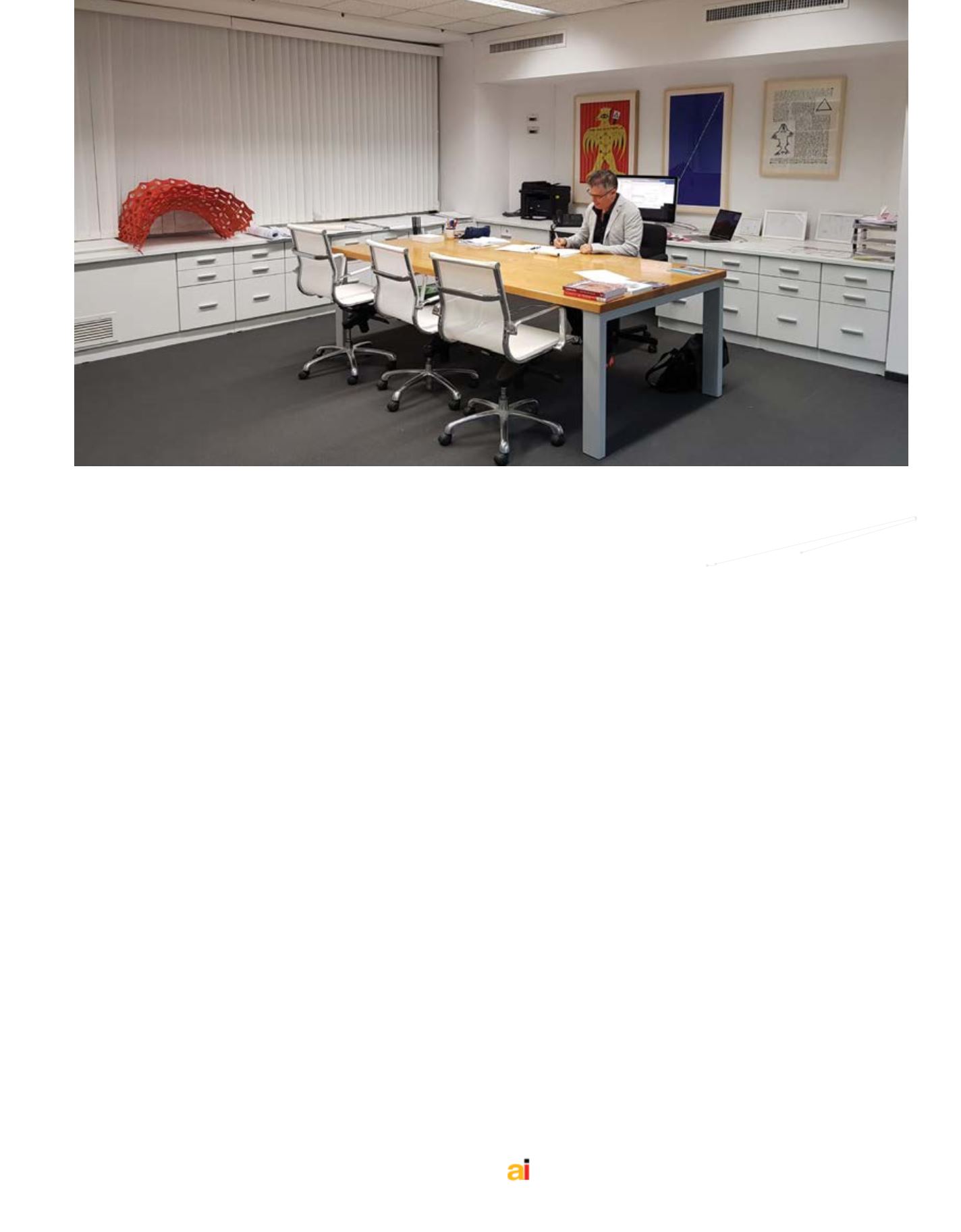
Architect Prof. Yasha Grobman in his office
at the Technion.
אדריכל פרופ׳ יאשה גרובמן במשרדו בטכניון.