



 15 / 96

2018
פברואר
112
אדריכלות ישראלית
|
עירוב שימושים
15
|
Interestingly, though, there is a rationale
behind the yearning for uniform order,
which was preceded by the Post Modern
fantasy riot, particularly expressed in the
‘Build your own home’ projects - which
evoked on one hand a nostalgic yearning
for Modernist order, while for the general
public it was a perceived as a liberation
from its severe, monotonous appearance.
It’s worth noting that while “mixed use”
enables random development according
to circumstances, it might serve as a
basis for conflict, since what makes one
person happy may mean no peace of
mind for someone else. And there are
infinite examples of this.
This is exactly why theorists define a
“good city” as “a place in which one can
meet friends, but also get lost”, or “a good
party where you stay longer than you
intended.”
I personally believe that a city, like reality
in general, is an unresolved battlefield
between various users: pedestrians vs.
electric bicycles and vehicles; tenants vs.
house owners; those who invite vs those
invited; buyers vs. sellers; those who must
make noise vs those who long for peace;
residents vs the municipality actually
supposed to represent them, but doesn’t
always remember it; cops vs robbers
(depending on your point of view); secular
vs religious; women vs men; young vs old;
capital vs governing - and the list remains
open to suggestion.
This reminds me that a few years ago,
looking for peace and quiet, I travelled to
the Greek island of Paros - a pale version
of Santorini, though inhabited by certain
“religious” people who see no necessity
for wearing a swimsuit on the beach.
Arriving at the Aegean island, we stayed
in a villa that fearlessly dipped its feet
into the seawater, allowing the restrained
waves to accompany the sleepy rhythm of
our breath.
Suddenly, without prior warning - except
for the tourist brochure which stated that
the island is also suitable for the young -
the blessed quiet vanished in an onslaught
of thundering bass-rich sounds of rock
music, which not even three cushions
could silence. We lay awake until grass
and adrenalin filled the dancers and they
fell into their daily slumber at 7am.
Today I know that in order to experience
the true meaning of “mixed use”, there
is no need to go as far as the Aegean
Islands; evidence of which are the
“Muezzins Law”, the “Supermarket Law”,
the “Private Swimming Pool Regulations”,
and the law of my nouveau riche neighbor
from the south, who is certain that I need
to pay with my peace of mind for the
music roaring out of his new speakers he
has fixed to the fence between us.
So the question is what?…
Today, when confusing alternatives of
urban renewal are on the agenda, and
knowing that they don’t really contribute
to tenants, but rather to entrepreneurs
drowning in money, and local authorities
who would also like to… it would be a
good idea to re-examine the misguided
urban cliché of “mixed use” - and the
sooner the better.
Gradually developing architecture on the
island of Paros, expresses as elsewhere,
a sensitive balance between innumerable
intentions.
Top and Bottom:
The Greek island of Paros.
Right page, top right:
"Ltaly" - an illustration
by late architect Kalman Katz.
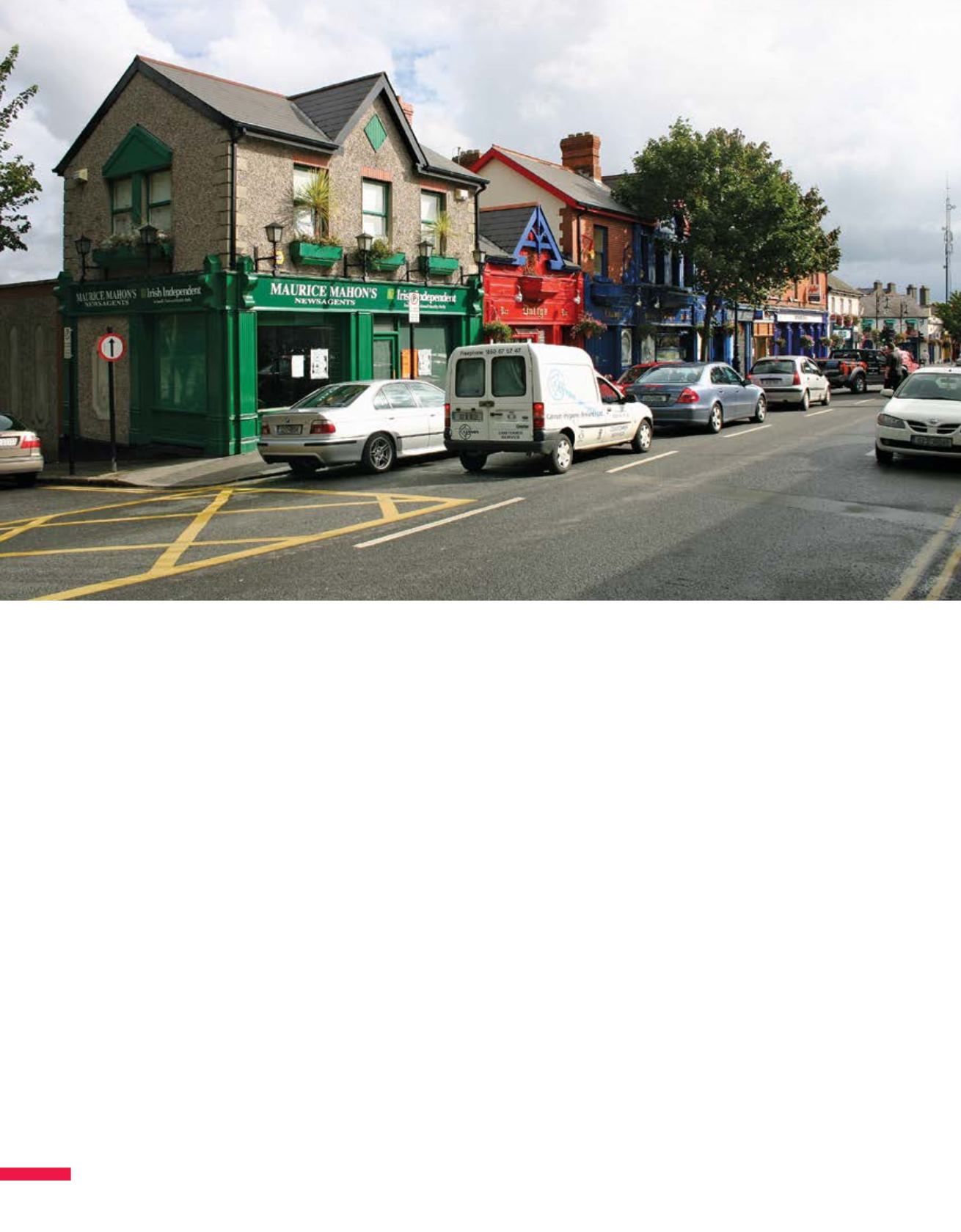
Left page:
Main Street, rich in content,
Galway, Ireland.