


 21 / 96

2018
אוגוסט
114 #
אדריכלות ישראלית
|
פחות או יותר
21
|
to minimalist modernism, and from
there - back to content loaded Post-
modernism, was natural, regardless of the
circumstances.
The transition from modernist style to the
formal negation of the minimalist concept
(wrongly) came from two directions:
On one hand, users who thought that
simplicity was too boring, and on the other
hand, architects who were looking for
ways of expression beyond the artificial
subjugation to function.
Prominent among these was modernist
Robert Venturi, who coined the cynical
phrase, ‘less is a bore’, arguing that the
modernist “truth” was no longer relevant,
since human beings (architects as well)
needed ornamentation for self-expression.
Venturi, who worked in Louis Kahan’s
office (who was born with the non-
minimalist name of Louis Isadore
Kahn), demonstrated the concept on
his own house in Philadelphia, where
the balanced, symmetrical facade was
violated by deflecting the chimney from
the center.
With the end of the post-modernist
cacophony that legitimized meaningless
affectation, I personally suggest replacing
the message with something more
moderate, like ‘more is less’, and the well-
known Hebrew phrase “anything added,
lessens”, is preferable to ‘anything added,
is perfect’, because it really isn’t.
In an era when aesthetic boredom stems
from over-design and computerized tricks
that no longer do it for us, the optimal
solution seems to be a comfortable
harmony betweenminimumandmaximum
– something that enables a reasonable
measure of personal expression - yet
not too clever, nor overly decorated, and
certainly not boring.
The cliché “beauty is in the eye of
the beholder” (not my own invention),
first appeared in the 1916 silent film,
Molly Bawn. The script was adapted
from the book by Irish writer Margaret
Wolfe Hungerford, though like anything
intelligent, the concept was already
known in Greece in the 4th century BC;
Shakespeare used it in several plays in
the 16th century, and ever since it has
been quoted in innumerable essays
dealing with the notion of aesthetics.
The heroine of the book - Molly Bawn,
was a “frivolous, annoying” Irish girl who
rebelled against the harsh social/religious
conventions.
Hungerford’s book is mentioned by
James Joyce in Ulysses in 1922, that
ended in a discussion about stream of
consciousness. Joyce himself is quoted
as saying about his book: “I’ve put in so
many enigmas and puzzles that it will
keep the professors busy for centuries
arguing over what I meant and that’s the
only way of ensuring one’s immortality”.
The concepts of conciseness and
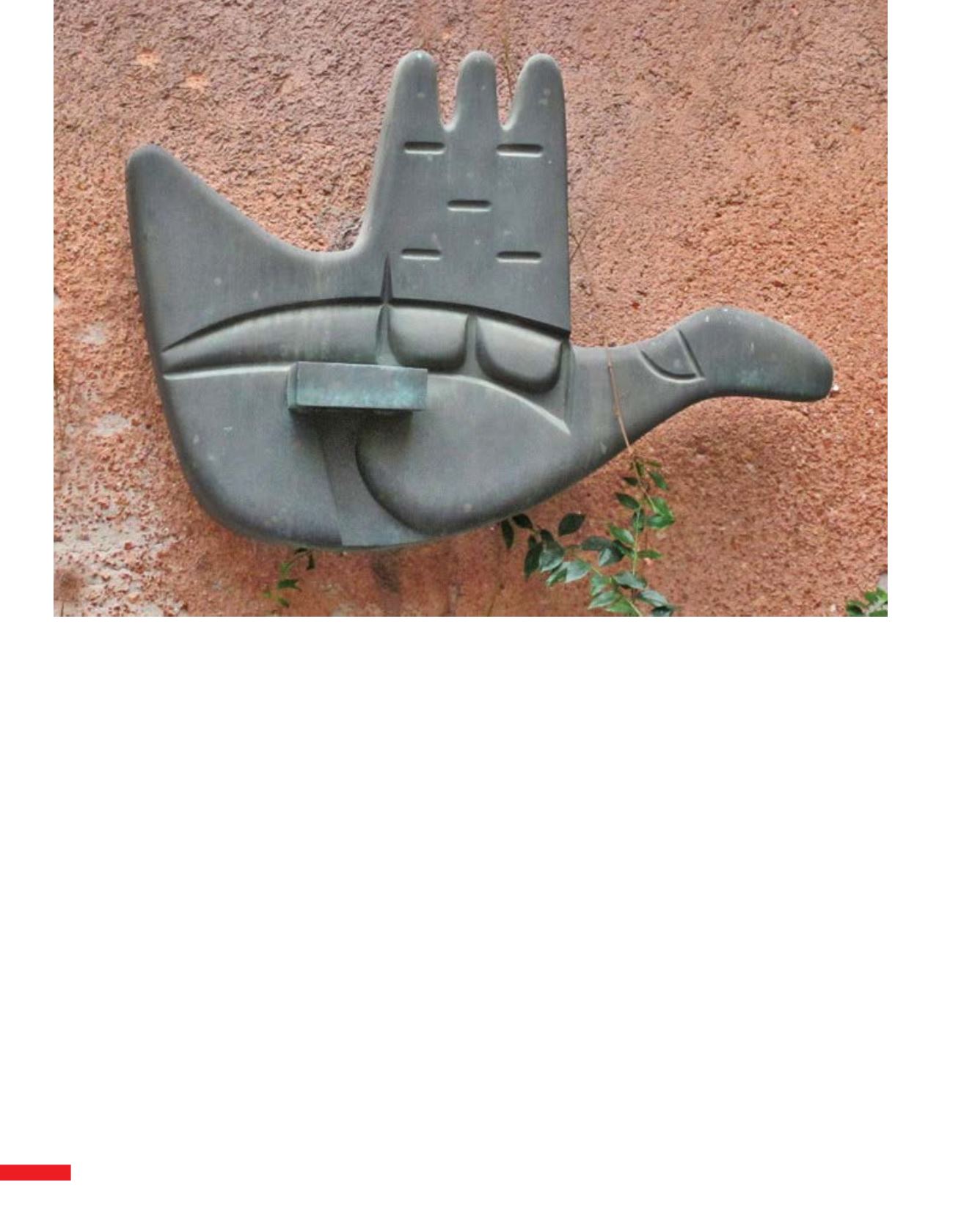
This page:
Le Corbusier's hand, appearing
in many of his buildings without any
functional purpose.
Right page:
The house of Florentine artist
Andrea del Sarto, hero of Browning's
dramatic monologue, in which the sentence
"less is more" appears a hundred years
before Mies van der Rohe.