



 81 / 96

2017
נובמבר
111
אדריכלות ישראלית
|
- קטגורית מחקר
2017
פרויקט השנה
81
|
Located between Yitzhak Sadeh Street,
Moshe Dayan Road, The Hagana Drive and
Netivei Ayalon, the Yad Eliahu neighborhood
was built by the Tel Aviv Municipality after
the Second World War to house discharged
soldiers of the Jewish Brigade.
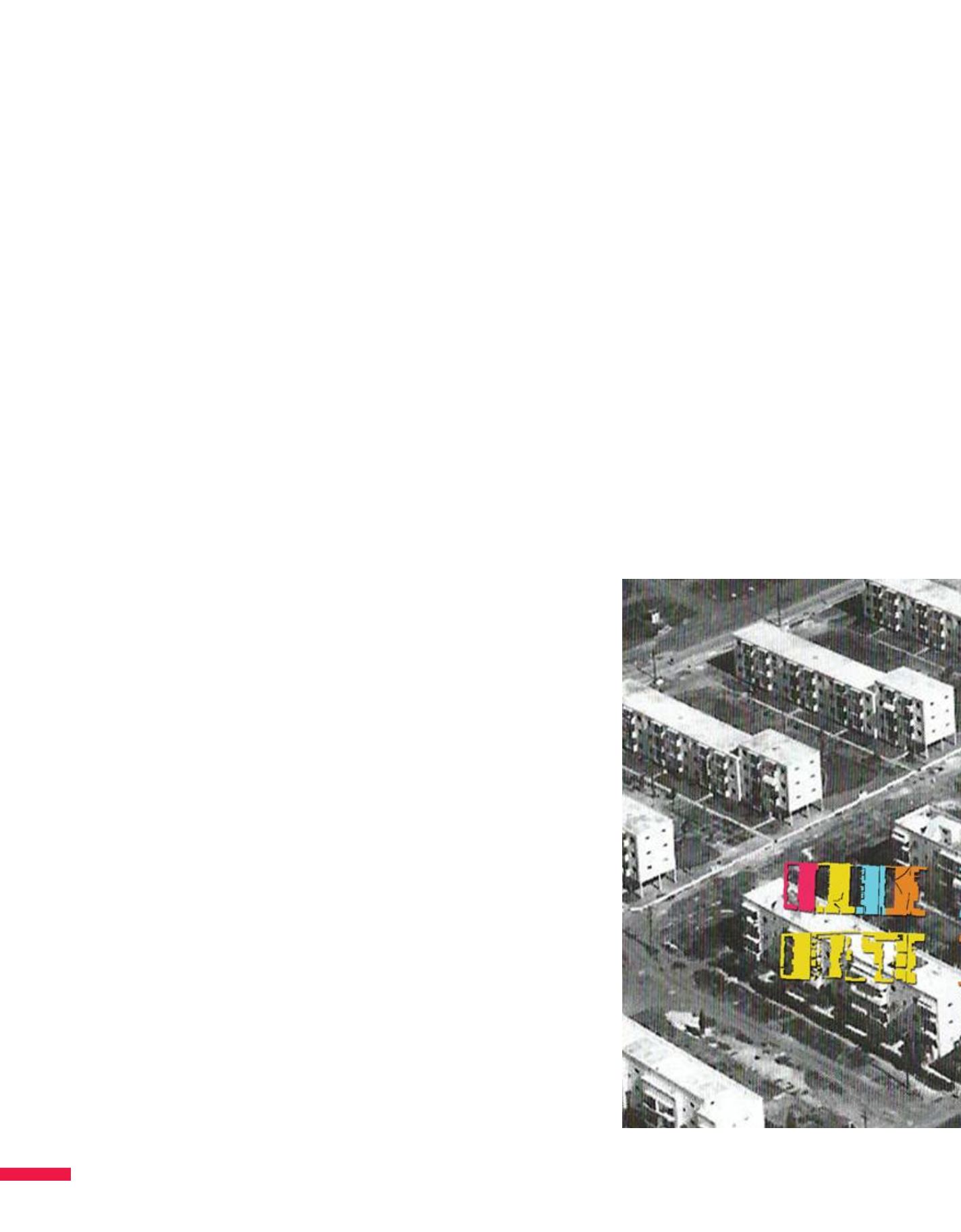
The organization of the open space in the
largest neighborhood in Tel Aviv (about
7000 residents) was based on Ebenezer
Howard’s Garden-City concept, using the
typology of the “Zeilenbau” developed in
Weimar during the twenties’.
This involves situating residential blocks
facing each other perpendicularly to the
street, thus establishing common back
yards, the width of which derived from the
height of the buildings to maintain sun, air
and light rights.
The underlying rationale of the plan was to
create small gardens for residents’ use, for
leisure and cultural functions – a meeting
place for social activities, sport, and games.
The nature of this hierarchy between private,
common and public spaces depends on the
relationship between individuals and their
social organization. Thus, for instance, while
the cooperative served as a way of life in
the workers’ dormitories of the 1930’s, in
Yad Eliahu the British Jewish Brigade only
served as an excuse to provide housing.
This is why the common spaces in Yad
Eliahu began evolving in a different way soon
after the first decade of its establishment.
It turned out that the open space in the
neighborhood had been neglected, inter alia
due to population aging.
Evolving Common Space
Yad Eliahu Neighborhood, Tel Aviv
Architect David Adraee, MSc thesis
Faculty of Architecture and Town Planning,
Technion Haifa
In this situation, entrepreneurs began to
see the neighborhood, which seemed
frozen in time, as a desirable real estate
asset, encouraged by the municipality that
attempts to advance urban renewal, likely to
yield enormous rates and taxes.
The purpose of the research was therefore
to spot social values in order to save the
uniqueness of this neighborhood from
the teeth of several renewal plans, which
threaten to change the definition of open
spaces.
Focusing on 134 buildings of varying scales
the research examined the situation during
three periods of time: the first years after its
establishment; the existing situation, and
the nature of future proposals.
The studied material included documents,
plans, interviews, observations, and historic
photographs.
Tutors:
Dr. Els Verbakel,
Prof. Elissa Rosenberg.
Dictated by the current housing shortage, densification prompts
a shift in the significance of open space, usually grasped as
potential for building and additions. In this light, the research
examines the role of common space as mediator between
private and public space in the Yad Eliyahu neighborhood.
P
rivate
O
pen
S
pace
מלגת עיר עולם
ביב
Right page, top:
Various expressions
of common activities - hosting, home
agriculture, and playing facilities.
Below:
Building positioning creates an
hierarchial order between private, common
and public spaces.