


 30 / 96

Architecture of Israel #
111
|
November
2017
|
Project of the Year Competition 2017 - Building Category
page
english
contemporary solutions attempt to be bi-
directional and multi-functional.
One may justifiably claim that adapting
structure to function is not new, since it
preoccupied modernists like Mies van der
Rohe, who later developed a versatile model
whereby the unknown plays an important
role, based on Le Corbusier’s ideas, but,
unlike him - with an inner circulation of
varying functions in a limited space.
His minimalist conception was expressed
in his well-known phrase ‘less is more’,
actually the antithesis of another expression
‘God is in the details’. To state that what
appears simple isn’t necessarily simplistic.
The idea that the real significance of a
building is not in the structure but rather in
what happens inside, is expressed by a no
less important modernist - Louis Kahn, who
designed the Trenton Bath House for the
Jewish community in New Jersey. Defined
by Kahn himself as a turning point in his
design perception, the structure is based
on functional circulation randomly occurring
between four concrete cubes enclosing an
And completely unrelated, the fruitful
collaboration between AI and the European
Union is now in its eighth year. The Project of
the Year competition still accepts hundreds
of submissions from all over the world, the
finalists of which are proudly exhibited here.
Taking place in six categories, the intention
of the competition is to locate applicable,
creative projects, reflecting climate and
environmental awareness.
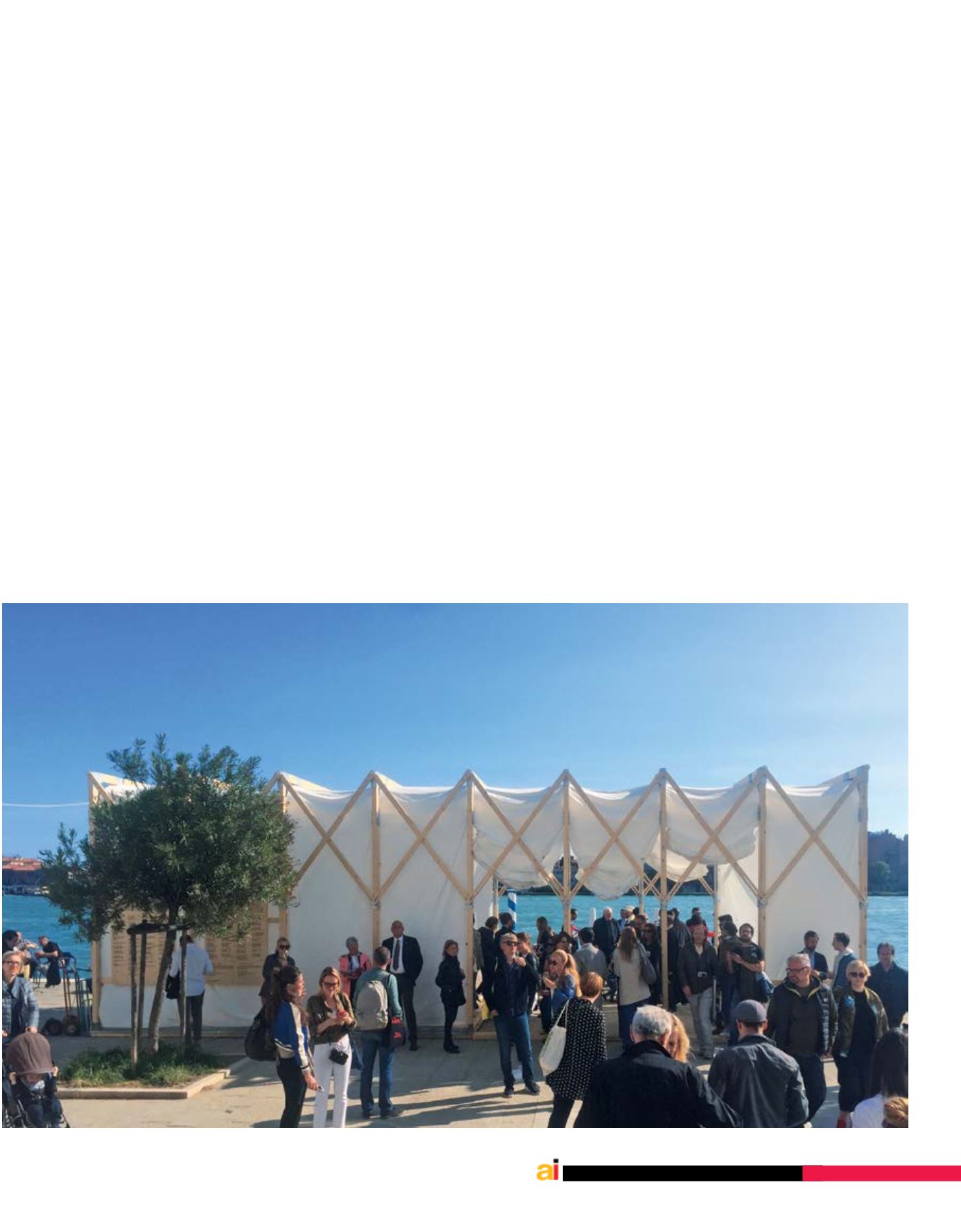
Designed by Omri Revesz for the 2017
Venice Biennale, the project below won
an Honorary Mention for its simplicity,
expressing a conventional rather than
computerized reference to the environment
without damaging it. Made of wooden
panels, the structure can expand and
contract according to circumstances.
internal courtyard. That is, the structure has
defined boundaries, yet functions are free to
re-shuffle according to changing needs.
The principle whereby simple is not
necessarily simplistic should be learned by
heart by startup architects, who have to re-
invent themselves, or disappear.
And this is the point at which the computer
with its malignant metastases turns from a
work tool into a degenerative apparatus,
and must be treated with extra caution.
It is not my intention to encourage a
conceptual freeze, certainly not by
negating the computer’s advantages, but
conventional architecture with its thousands
of configurations has proved that mere
formalism has no advantage over simple
function-aware buildings, even though they
cannot expand or contract with a sensory
whisper.
Which goes to show that architectural
stability is yet necessary, and the question
of who is in the details – God or the Devil – is
only a matter for interpretation.
Street Cinema - folding structure designed
by Omri Revesz for the 2017 Venice Film
Festival at the Venice Biennale 2017.
67