


 94 / 96

Interview with Architect Asaf Lerman
Architecture of Israel #
109
|
May
2017
|
page
english
Asaf Lerman was born in Tel Aviv in 1969. After 10 years of study, he exchanged High
School for photography and film making studies at Camera Obscura. He served in the
Armored Corps, traveled the world for three years, and landed in London to study at
the AA. In 2000 he returned to Israel as an architect and joined the family architectural
business - Lerman Architects. In 2006 he established his own firm, almost immediately
becoming involved in huge budget projects. Asaf is a member of the Bezalel academic
staff and also teaches at the Faculty of Architecture at the Technion.
3
interview with architect asaf lerman
in the name of the mother,
the father, the uncle and
belief in myself.
I go to the sea
only when there are high waves
Architect Dr. Ami
Ran
In contrast to most architects for whom
architecture is an acquired language,
for you it is actually a mother-tongue,
something you were born to and grew
up in.
True. I think that over and above the fact that
architecture is a natural language for me, it
is part of who I am - consciously or not, it is
my personal story. I grew up in the house of
two architects - both of whom also grew up
in the profession. My father was apprenticed
to his uncle Yosef Segal - whose father
Yechiel was the first landscape architect in
Israel. In 1922, he designed the Gruzenberg
Gardens – the first public garden in Tel
Aviv; in 1924 he designed the garden at
Bialik House; Sderot Yerushalyim and the
Dajani Hospital in Jaffa; Binyamin Gardens
– the first public garden in Haifa, and Park
Hayarkon, which his son Yosef continued
to develop. My maternal grandfather was a
senior Engineer at the Ministry of Defense.
When did you first think of architecture
as a profession?
It probably began with our own house, which
my parents designed - their best work so far
in my opinion. The conversations at dinner,
the library and later on, vacation work at
their office, getting involved in influential
projects, such as the road from Eilat to
Sharm, the Ichilov Hospital Tower at Tel Aviv
Medical Center, several wings and Kikar
Hayovel at the Weizmann Institute; Tel Aviv
Music Conservatory; Mtizpe Ramon Visitors
Center; and the Ziv Towers in Tel Aviv.
I read on your web page that you love
your work and believe in what you
do. What do you really believe in, not
necessarily in terms of architecture?
I look for the moment at which something
new is born, like the vital instant when you
grasp a banal idea in a new way - something
like the “vibe” behind the Modernist idea.
In the swirling digital reality, I see this as
my role and responsibility as an architect.
Beyond the response to the necessity of
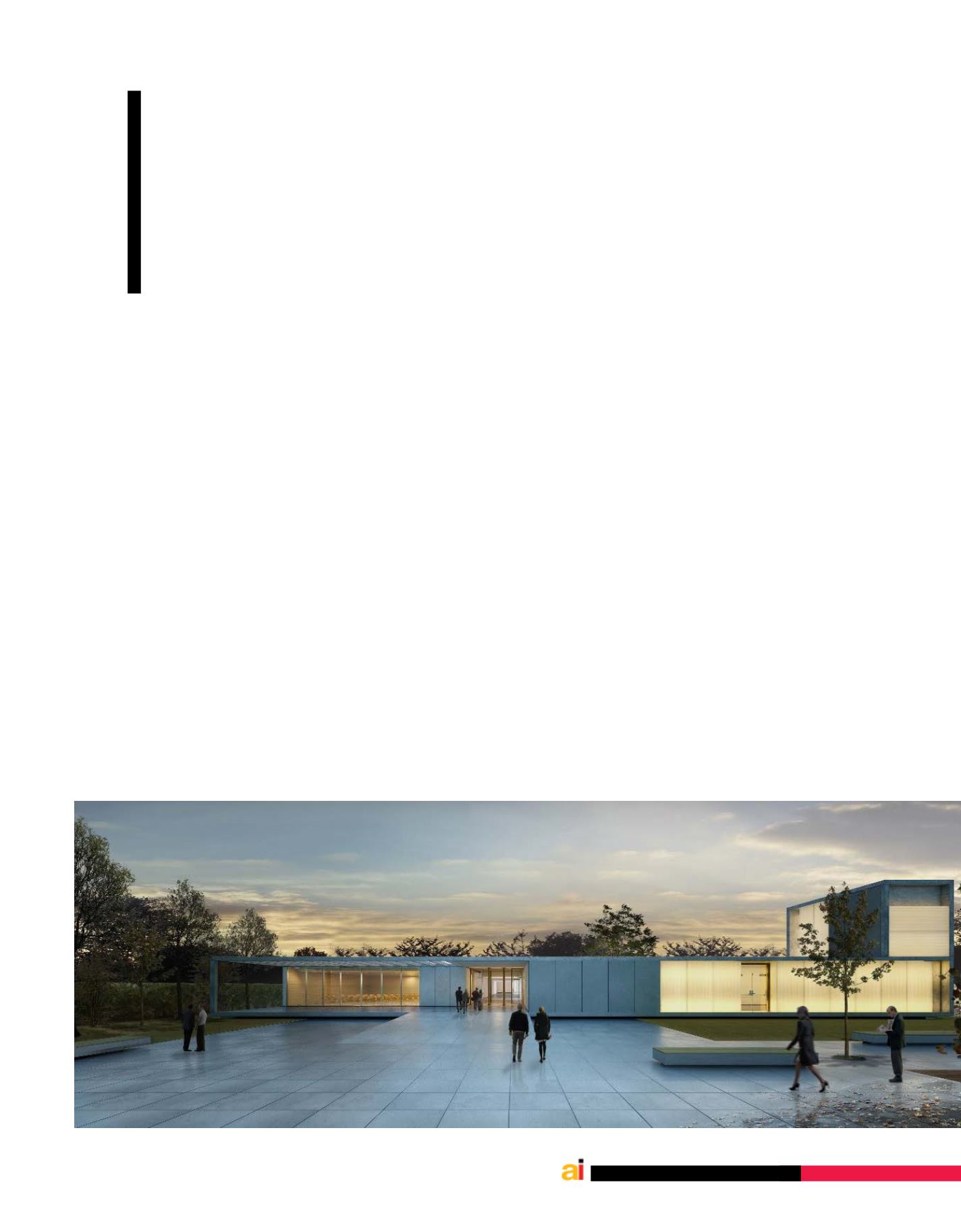
מרכז תרבות, מערב הרצליה (פרויקט בתהליך)
ניסיון להטמיע מבנה ציבורי בינות לווילות מסתגרות.
א. לרמן אדריכלים
רפי בט.
קונסטרוקציה:
Culture Center, west Herzliya
(project in progress)
An effort to "plant" a public building in a row of private villas.
Asaf Lerman Architects