


 63 / 96

2019
מאי
117
אדריכלות ישראלית
|
גיבוב אדריכלי
63
|
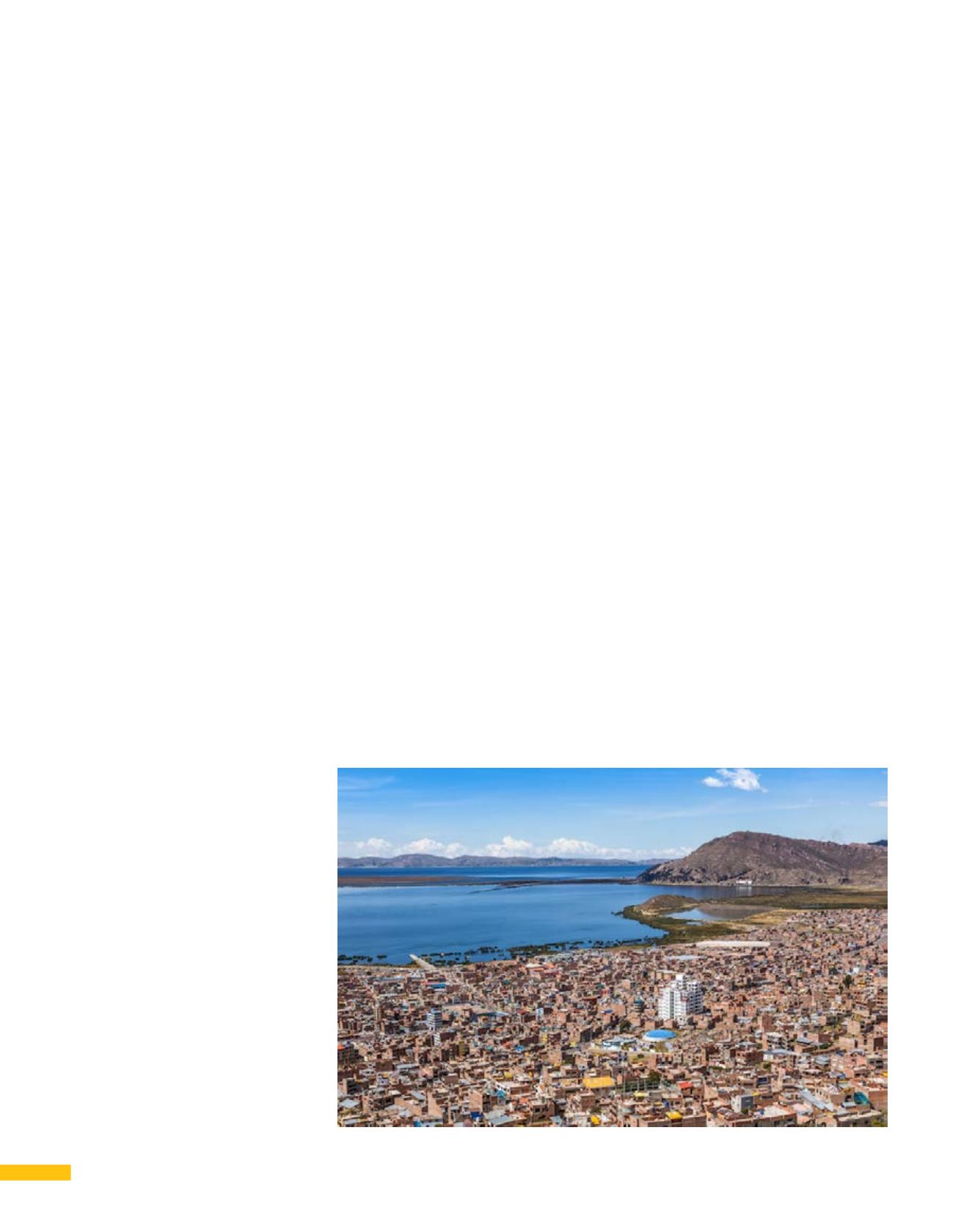
Below:
The organically developed city of Puno, Peru.
Right page (onwards):
Renovated house, La Esperanza, Iberia, Ecuador, 2016
Built at the end of the eighteenth century, the dark, cold, single-story house appears to be a
hopeless case – rotten roof, doors and windows, broken floor and damaged walls.
The family, who did not insist on traditional private bedrooms, asked for a simple house with a
kitchen, living room, dining corner, common bathroom and personal sleeping corners.
Adhering to traditional building and sustainable principles, the architect focused on reinforcing
the walls, plastering and painting them; installing a bare, polished concrete floor; replacing
doors and windows; and installing a skylight that floods the space with natural light.
The result stands out with its timber construction supporting the sleeping galleries, a new
timber roof covered with tiles made of old tires, and a eucalyptus pergola, which gives the
patio its new meaning.
Hence, neutralizing chaotic elements
in stacked situations is what facilitates
today’s algorithmic management of
complex urban systems.
Online reality has changed our life style,
casting a shadow over the achievements
of architecture that fails to adapt to it.
Many spaces are abandoned as a result
of online lifestyles – from filling out forms,
paying via the mobile, orientated via
WAZE, parking with PANGO, to working
on a laptop.
In this context, one should strongly
condemn municipalities for still being
hostage to irrelevant legislation – some of
this over 80 years old, the worst of which
is the Expropriation Law that mercilessly
violates individuals’ property rights in the
guise of public interests. Based on the
British Land Ordinance passed in 1943,
when Churchill was Prime Minister of
Britain, the law was used to implement
the United Kingdom’s colonization of half
the world.
Statutory systems are still burdened with
irrelevant master-plans forcing architects
to adhere to anachronistic technologies,
such as roof tiles that are thousands of
years old, or uniform sign posting lacking
in unique dimension. All are controlled
by offensive bureaucrats with neither
planning experience nor connection with
reality.
Progress admittedly has a price and,
like any short-cut method, the solution
becomes part of the problem, when
natural stacking that is supposed to
express events, identities and random
connections, is replaced by instant
products that express the creative urges
of the architect, neutralizing the random
dimension that provides architecture with
its dynamicity, its human dimension, and
joy of life.
In an online reality where everything is
exposed, controlled and monitored by
cameras and sensors, architecture has
an even more crucial role - on the level
of the place, community, and particularly
on the level of individuals, who have lost
whatever privacy they once had.
And instead of confining architecture in
design limitations, laws and regulations,
diversity should be allowed to break the
frozen monotony expressed in spatial
uniformity that stems from indiscriminate
construction lines. Moreover, one of the
most blatant problems in terms of available
building areas is that today it is impossible
to design the inner courtyards that were
once a distinct feature of Mediterranean
Architecture. Over and above the fact
that courtyards provide protection from
extreme weather changes, they constitute
a private domain where one can do as
one pleases.
In light of a severe housing shortage, most
building today is housing related, where
the final user is completely anonymous,
and changes or personal adaptations are
totally forbidden, so as not to violate the
“sacred” uniformity of design.
In this context, it is surprising that recent
amendments to the Planning and Building
Law were primarily meant to grant
unlimited power to local municipalities at
the expense of individual freedom and
property rights.
Caught between limitation and desire, the
ordinary citizen finds it difficult to express
his wishes, trying to do so immediately
after the occupancy stage, if at all.
And in this reality, the municipality, meant
be serving the public, becomes its number
one enemy, and evidently most legal
budgets are directed against residents,
who ironically fund them out of their own
pockets.
And in conclusion, with the stacking
situation expressing limited creative
intention, it seems that synthetically piled
up buildings will continue to prevail over
organic architecture, that once expressed
open and random creative intentions.
איכויות הגיבוב האורגני באות לידי ביטוי באדריכלות
בת קיימא היודעת למנף את איכויות המבנה הקיים
לטובת החדש.
גיבוב הנבנה במהלך השנים כאי-אלמוגים
למטה:
בעיר הפרואנית פונו.
בית הגלריות המרחפות.
בעמוד הימני:
במקום בית חד-קומתי חשוך וקר, חלל דו-מפלסי
חמים ומואר.