


 52 / 96

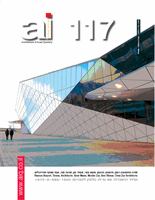
Architecture of Israel #
117
|
May
2019
|
Atarot Mall
page
english readers
The new Atarot Mall is worthy of attention
as it may well serve as a social bridge
between the Jewish population on the
one side of the separation wall, and the
Palestinian population on the other.
Located in the Industrial zone near the
Beit Horin junction and the Ramallah
road (east), the Mall is both far from the
city-center and far from being a buyers’
attraction.
Lacking in any identifiable urban context
it was difficult to assimilate the 30,000
meter mall facing the separation wall
between the western and the eastern city.
The building is light-stone-clad to serve
as a passive background to the colorful
store windows, while the Mashrabiya
eastern motif constitutes a conceptual
way of integrating the building into
its surroundings. It serves both as a
functional traditional partition, allowing
the penetration of natural light, as well
as an abstract element appearing in the
graphics, the marble flooring, and the
printed glass of the entrance structure. At
dark, the internal illuminated activities are
reflected outside.
The idea of attracting buyers from a broad
variety of populations initially seemed like
a security problem. However, like Rami
Levy’s other revolutionary ideas, the Mall
is a tested way to create a social bridge
between Jerusalem residents in general
and surrounding villages in particular.
social
spatial solidarity
atarot mall jerusalem
Had it depended on ordinary people and not on politically motivated leaders, it
is likely that the relationships between the various sectors in Israel would look
different. This is because daily interaction based on existential needs is always
stronger than any other factor. It isn’t without reason that Arab laborers are prepared
to do anything in order to make a living: get up at four in the morning, walk for
miles, reach the border crossing, undergo security checks that are anything but
a pleasure, and travel for many kilometers to start working at six in the morning at
jobs no Israeli is willing to do. This, while many Israelis are addicted to the smell of
fresh products offered in Arab villages, enjoy wandering around markets, standing
in line at authentic restaurants, adhering perfectly to Emil Durkheim’s definition of
the "organic" (spatial) solidarity conducted between differences – as opposed to
"mechanical", trans-spatial solidarity that exists between the similar.
Approximately 250,000 inhabitants who
until recently had to travel to the Talpiot
or Malchah Malls in the south of the city,
can now enjoy a mixture of 40 chain
stores that carry leading brands, as well
as restaurants, cafes, and a large popular
supermarket.
In this context, space organization plays
a great role mainly in the intermediate
areas. Located near the separation wall,
the idea does raise security concerns, but
its social advantage is already proven:
the Mall constitutes a natural arena for
random interaction between religious,
secular, Jewish and Arab populations.
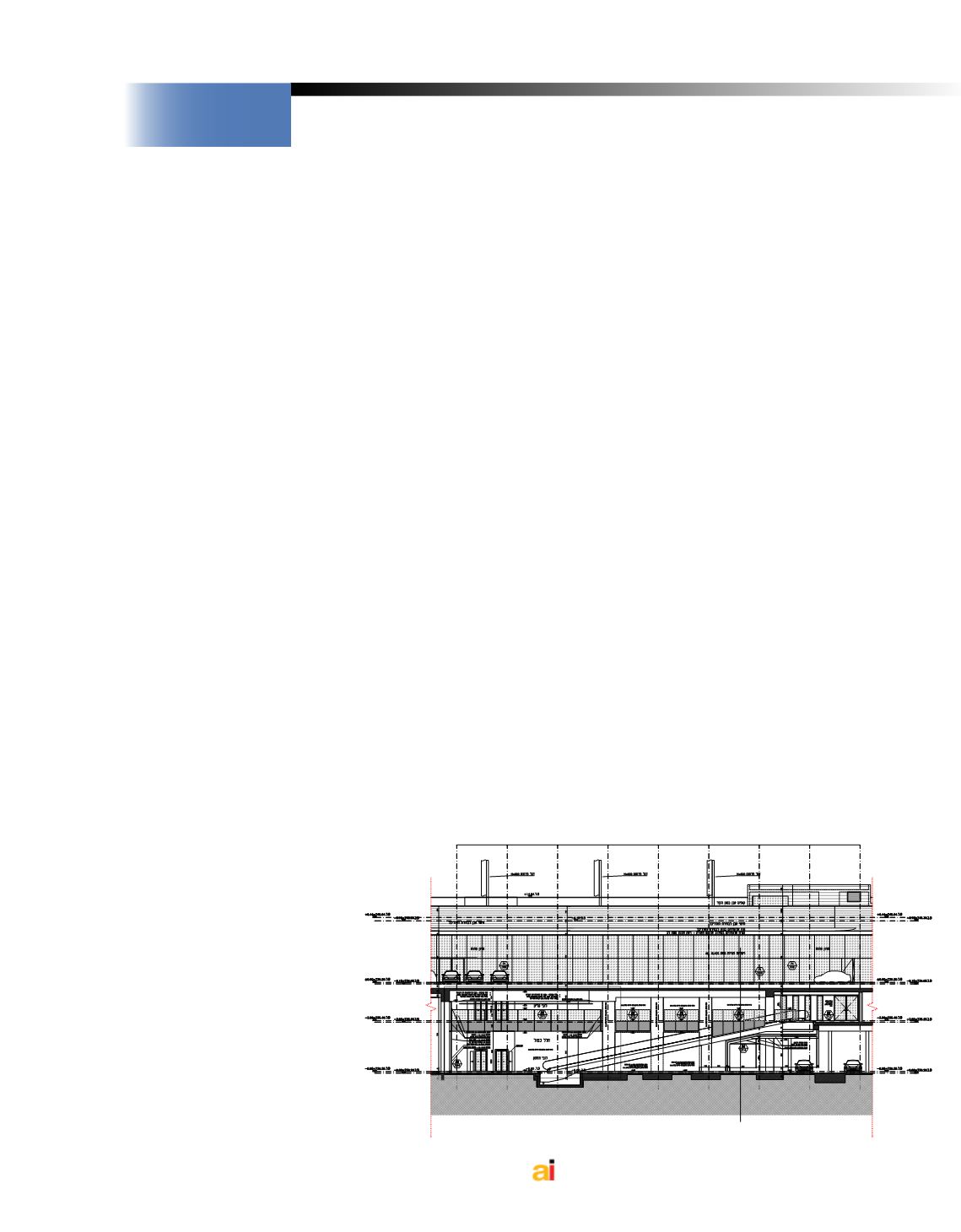
Built on two levels the Mall is placed
between the three parking lots. Located
on the upper parking level against the
silhouette of the nearby Mosque, a glazed
entrance in the upper square leads to the
commercial Mall beneath.
The square contains food stores and
restaurants with seating areas that lend it
the nature of a public space, connected
to a 5,000 sq.m. Rami Levi supermarket,
which in recent years has become a
"pilgrimage" for supermarket consumers
across the country.
Chen Architects Ltd.
Office Partner: Nili Chen.
Project architect:
Micha Polison.
Photos:
Shai Epstein.
45