



 83 / 96

2018
פברואר
112
אדריכלות ישראלית
|
קינג׳ס קרוס
83
|
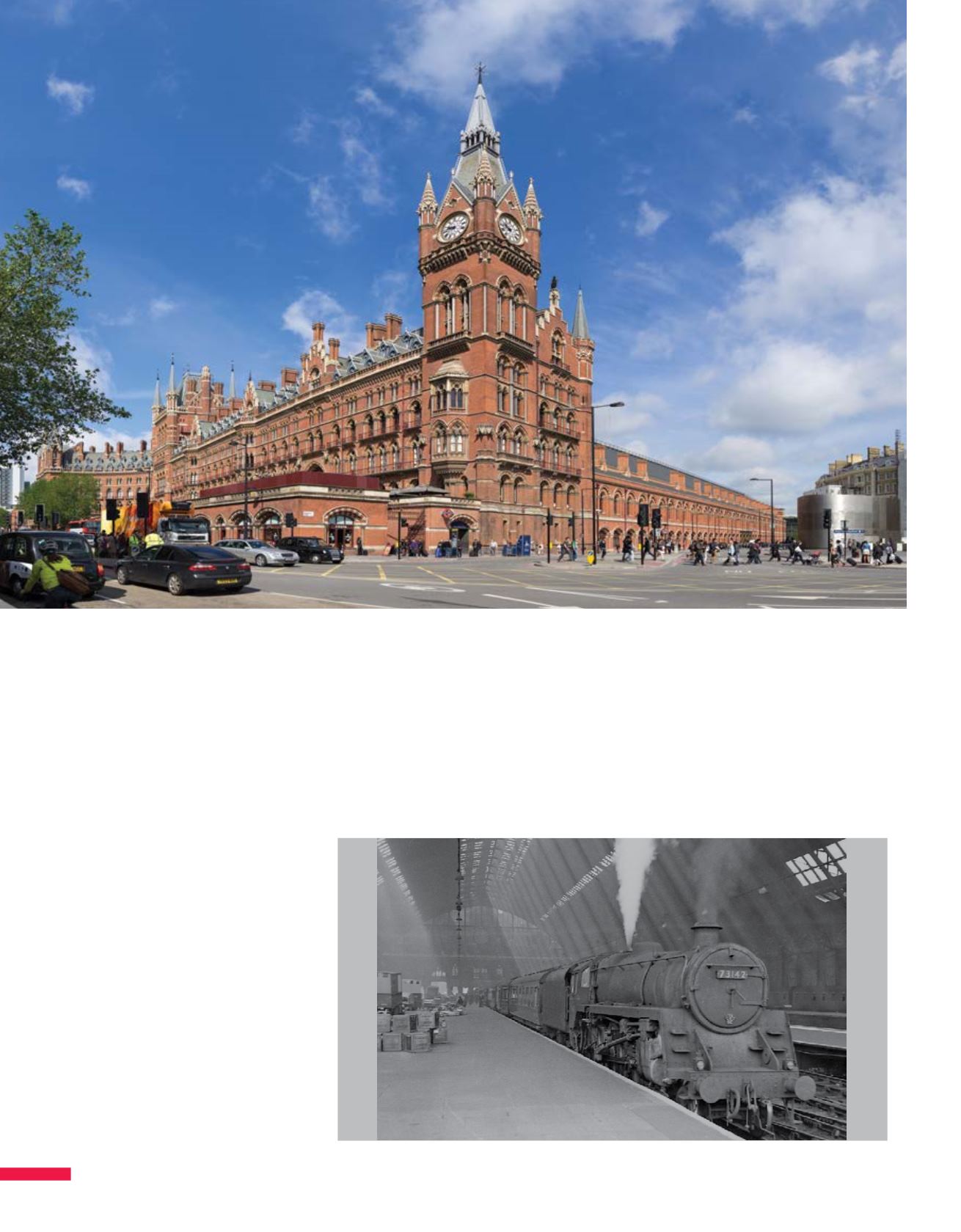
St Pancras Station in all its splendor, designed in 1963 by architects
George Gilbert Scott and William Henry Barlow, became a Eurostar
terminal in 2007 at the end of the Paris line.
Below:
St. Pancras Station in 1952.
A fundamental problem of the complex in
terms of accessibility is that it is split by
the Regent's Canal, built at the beginning
of the 19th century in order to connect the
Thames with the Paddington Arm Grand
Union Canal, as well as the railroads
connected above ground to St. Pancras
Station.
Nonetheless, access to the stations was
still enabled organically from the city
center via St. Pancras Road, Gods Way
and York Way and, in the north, from
Camden Town and Barnesbury.
However, in accordance with one of Peter
Bishop’s 10 iron rules, he probably relied
on the design approach of the 90's (which
ultimately proved misleading), thus the
new project was deliberately neutralized
from private vehicles, allowing access only
by foot, bicycle or public transport, with
limited access for commercial vehicles.
This imposed spatial detachment turns
the entire complex into an urban island,
completely dependent on the King’s Cross
Development Company – giving it an
enormous economic advantage, forcing
residents, store owners, businesses
and tourists to pay exorbitant prices for
monopolistic services - very much like the
exorbitant prices of popcorn in cinemas.
This movement block nullifies the
significance of most of Bishops declared
intentions - particularly with regard to
preserving the historical generative
principles of the city, and the social-
spatial advantages inherent in mixed use.
All this (as mentioned) is in utter contrast
to London’s successful redevelopment
projects, such as Covent Garden during
the sixties’, Queen Street in the seventies’,
and Camden Town in the nineties’ – where
only general outlines were charted, yet
enabling further interpretation according
to circumstances.