


 31 / 96

2017
פברואר
108
אדריכלות ישראלית
|
ריהוט רחוב
31
|
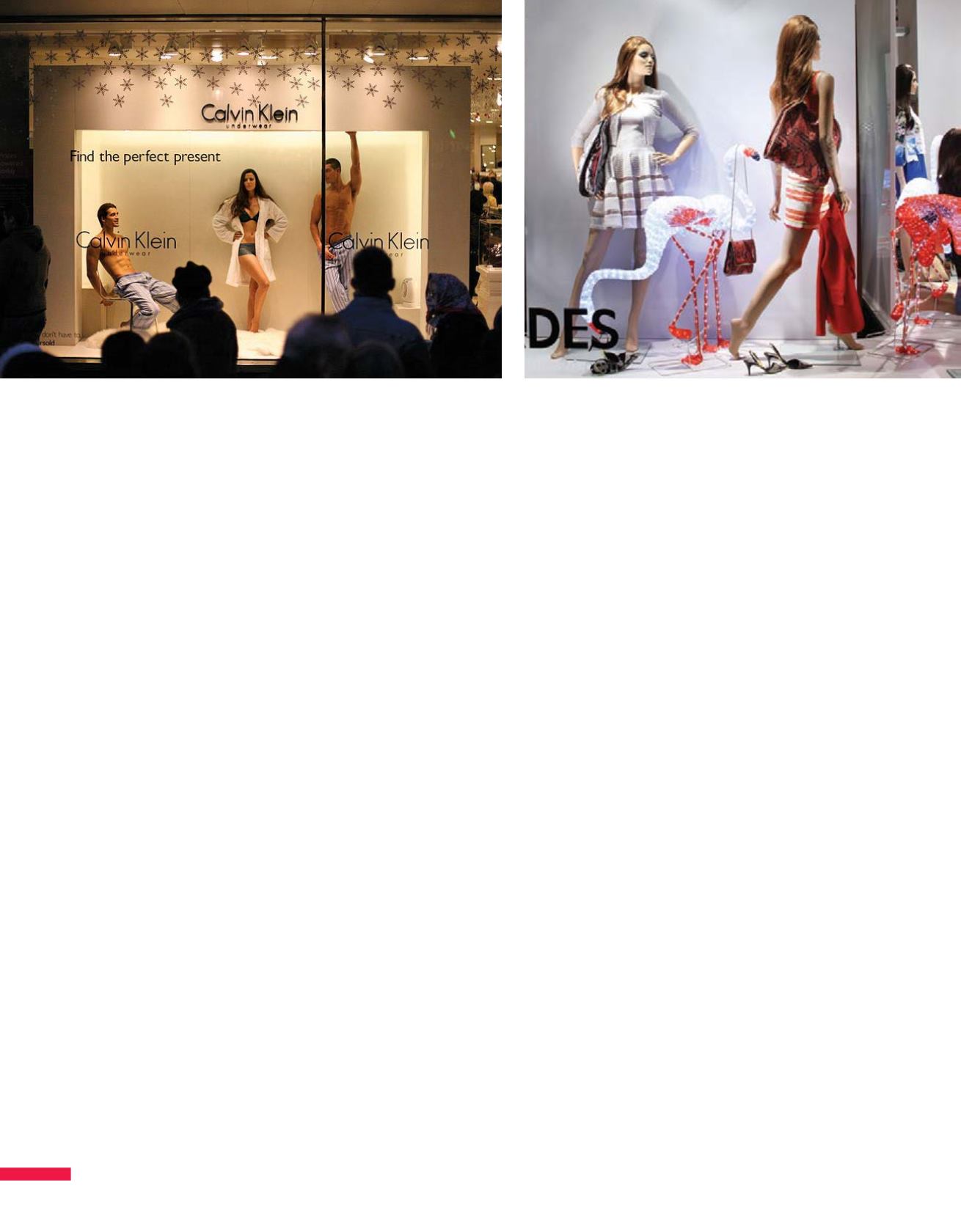
Heralding change of fashions, shop windows
offer the most creative details of street
furniture.
Top, left:
Calvin Klein shop window, London.
Top, right:
Miami Vice, Rhein Jades shop
window
,
Dusseldorf, Germany.
Right page, bottom:
Paris, artistic
interpretation of the song Who Knows the
Man in the Wall.
pleasant domain, by frequently situating
benches at observation points overlooking
natural or built landscapes.
In this frame, the bench adapts to its
surroundings, particularly climatically. This
makes the shape of the bench, its length
and location less important - thus inviting
togetherness by turning inward or ensuring
privacy by facing outward.
Unfortunately, planning authorities in Israel
don’t seem to understand the principle,
categorically separating the bench from
landscape and shade (particularly noticeable
on the Tel Aviv beach promenades).
Needless to say, a bench without protection
from the burning sun in summer, or rain and
wind in winter, puts this important function
at risk of remaining an unused, though
important street detail.
In this respect, the cardinal issue of
vegetation is missed in favour of carpets of
seasonal flowers and artificial grass. This,
while trees are not only capable of providing
friendly shade over benches, but also of
improving air quality, and reducing the
temperature of the immediate surroundings
by 10 degrees.
The most prominent street “furniture” in
Israel are the green garbage containers
and orange or blue recycling facilities that
belong to private companies which, under
the guise of "environmentally friendly",
have become a widespread imposing
design factor. Albeit necessary items, in a
situation whereby container manufacturers,
corporate recycling profiteers, and the so
called Ministry for the Protection of the
Environment rule the roost, the shabby
design of public places is dictated by
garbage trucks.
Recycling has inadvertently promoted the
issue of environmental sculpture, seeking
new materials and content, mainly those
carrying content from other worlds –
bottles, packing, plastic, tires, computers
and electrical devices, which go out of
fashion long before they go out of use. The
advantage of this, relative to conventional
sculpture, is the insistence on usability,
imparting to sculpture a practical dimension
in the form of benches, game facilities,
fences, and so on, and is also inherently
educational.
A less educational issue with grave
impact on street experience are electric
bicycles that take over the pavement, until
recently regarded a pedestrian's shelter.
The phenomenon, which primarily excites
youngsters, makes many adults look like a
contemporary version of Edvard Munch’s
Scream.
Less scary, more amiable “pictures” are the
shop windows that give the street depth
and actual dimension. Expressing what we
do not yet possess but usually desire, they
creatively announce the change of seasons
and the coming fashion.
If the street is the public’s home, graffiti are
like the notes we leave on the refrigerator.
Exempt from the question of determining the
boundary between art and vandalism, it is
important to note the unique skill of graffiti
artists, who have to act quickly and under
stressful conditions.
Hence, graffiti artists of the seventies’
gave this street activity new status, mainly
due to the invention of color-spray. Street
gangs began to mark territories conveying
messages of control. When there were no
walls left, activitypermeated theunderground
including the sides of the carriages, winning
huge rating for artists such as Keith Haring
and Jean-Michel Basquiat, the latter dying
from drugs at the age of 28. Both began
their careers on the streets of New York and
developed as respected artists whose work
is exhibited worldwide at important modern
art museums. Likewise, Mexican artist
Diego Rivera – a cynical socialist whose
provocative work aroused a scandal both
in the United States of America, Rockefeller
Center, and in Mexico (see AI #48).
And for dessert – an important yet painfully
ignored street facility – the public toilets. It
is highly probable that their absence from
our public domain stems from “Shulchan
Aruch” by Joseph Caro, that allows people
to relieve themselves in the street provided
they close their eyes and say the “Asher
Yetzer”.
Whatever! It is difficult to ignore the fact that
in order to relieve oneself in Jerusalem (for
instance), one has to visit the Old City. The
subject was dealt with at length in AI #46
under the title “Private Moments in Minimal
Conditions”, and we decided to mention
only the main points again:
Contrary to the noble qualities of the human
body frequently described in poetry, music,
and art, its discharge process is for some