



 30 / 96

Street Furniture
Architecture of Israel #
108
|
February
2017
|
page
english
reason considered shameful. And this is
surprising because the ability to take care
of removal by means of central sanitation
systems has always constituted a measure
of human progress. Namely, the more
sanitized a society, the more developed it is
considered to be, and vice versa
Accordingly, the main argument of the article
was that culture is judged by its toilets.
Interestingly, contrary to prevailing belief,
habits of relieving in the east are far more
developed than in the west. Research
indicates that European culture took a
significant step in this direction only after
the Crusaders acquired some of the
Muslim washing customs. However, until
the American Joseph C. Gayetty invented
toilet paper in 1857, the newspaper was a
satisfactory solution, which by the way, also
dispelled boredom.
The first flush toilet (water closet or WC)
was developed by an Englishman, John
Harington, at the end of the 16th century.
However, the use of flush toilets in Paris
only occurred for the first time in the 18th
century, following the accomplishment of the
underground sewage system.
With the advent of the Industrial Revolution
in the 19th century, the manufacture of
toilets began with a tap and a cast iron
sink as well as a porcelain toilet bowl that
could be easily cleaned. The upper water
cistern was developed in 1870, and the
lower cistern in 1915. The wooden seat that
became popular only at the end of the 19th
century, was replaced in the 20th century
with bakelite, the forerunner of plastic.
One culprit here is the Planning and
Building Act of 1965 that determines
minimal conditions instead of setting optimal
practice guidelines. The problem is that in
time, these minimal conditions become a
designer’s handbook, and all relate to these
as if instructed by God.
An extraordinary example of this is the
impossible size of the toilet cabinet, in which
one is forced to climb up on the bowl in order
to enter, or endure the doubtful pleasure of
brushing up against a wet seat.
Black humour has grown up around this
subject and one theory is that this is,
perhaps, the public’s way of expressing
dissatisfaction at the dreadful contempt
for one’s privacy while crapping in unison,
when the thin partition walls do not conceal
embarrassing noise, not to mention the
smell followed by shaming encounters.
And finally, in a global era when we all buy
כמבשרי חילופי העונות והאופנות, חלונות הראווה
הם הפן היצירתי של ריהוט הרחוב.
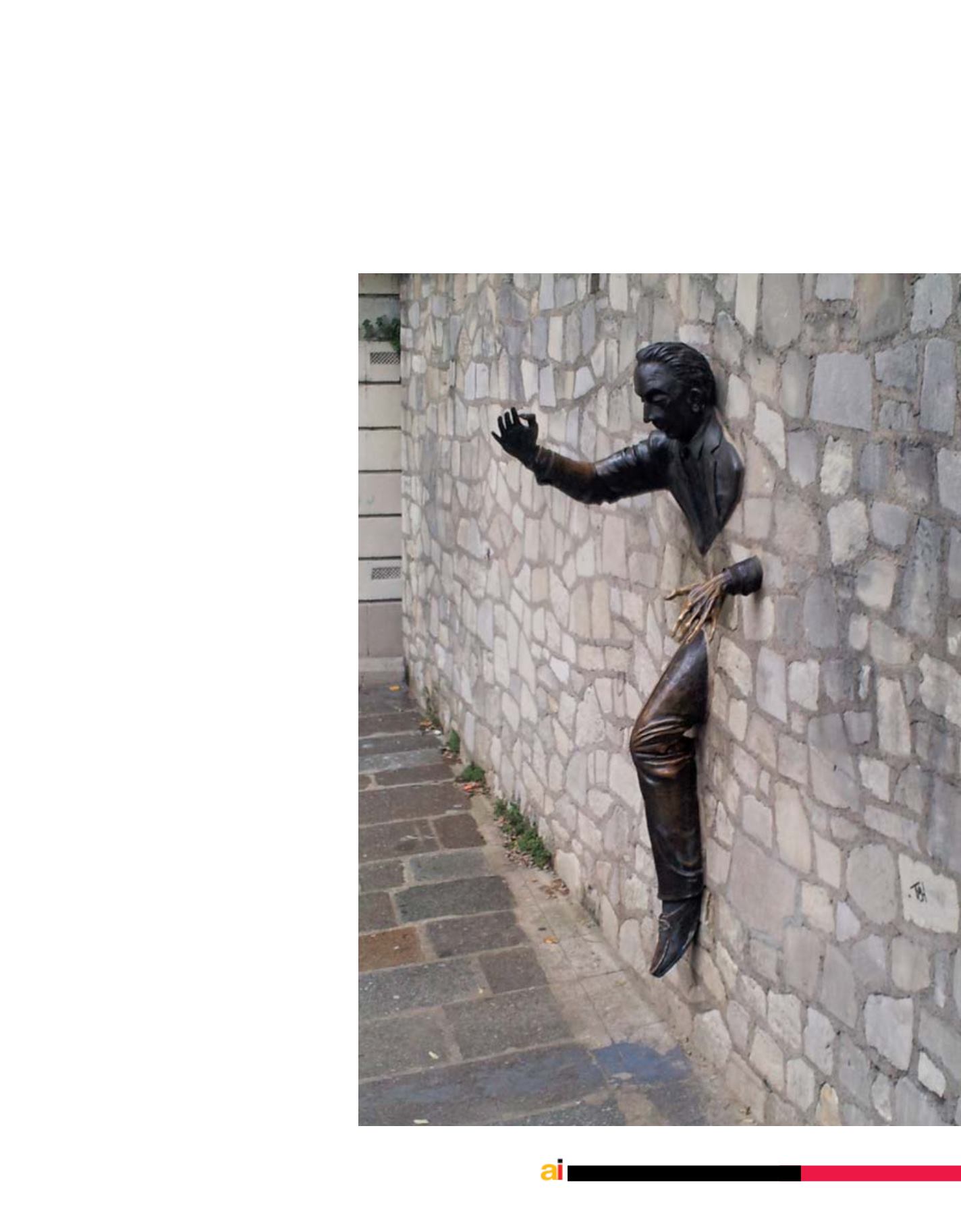
אינטרפרטציה אמנותית בפריז לשיר ״מי
למטה:
מכיר את האיש שבקיר״
חלון ראווה של
בעמוד השמאלי, למעלה מימין:
Miami Vice at Rhein
חנות אופנת הנשים
, דיסלדורף גרמניה.
Jades
חלון ראווה של קלווין קליין
למעלה משמאל:
בלונדון.
clothes from China via the internet in order to
wear them in Finland, and global technology
is universally available, the meaning of
place disappears together with the potential
of street furniture to convey local content.
As architect theoretician Hillel Schocken has
said: Designers are laboratory technicians,
and the city is the sum of their mistakes –
stop signs that require one to look right and
left, absorb reality, and explore what can
and should be fixed.
67