



 16 / 96

House of the Season
Architecture of Israel #
109
|
May
2017
|
page
english
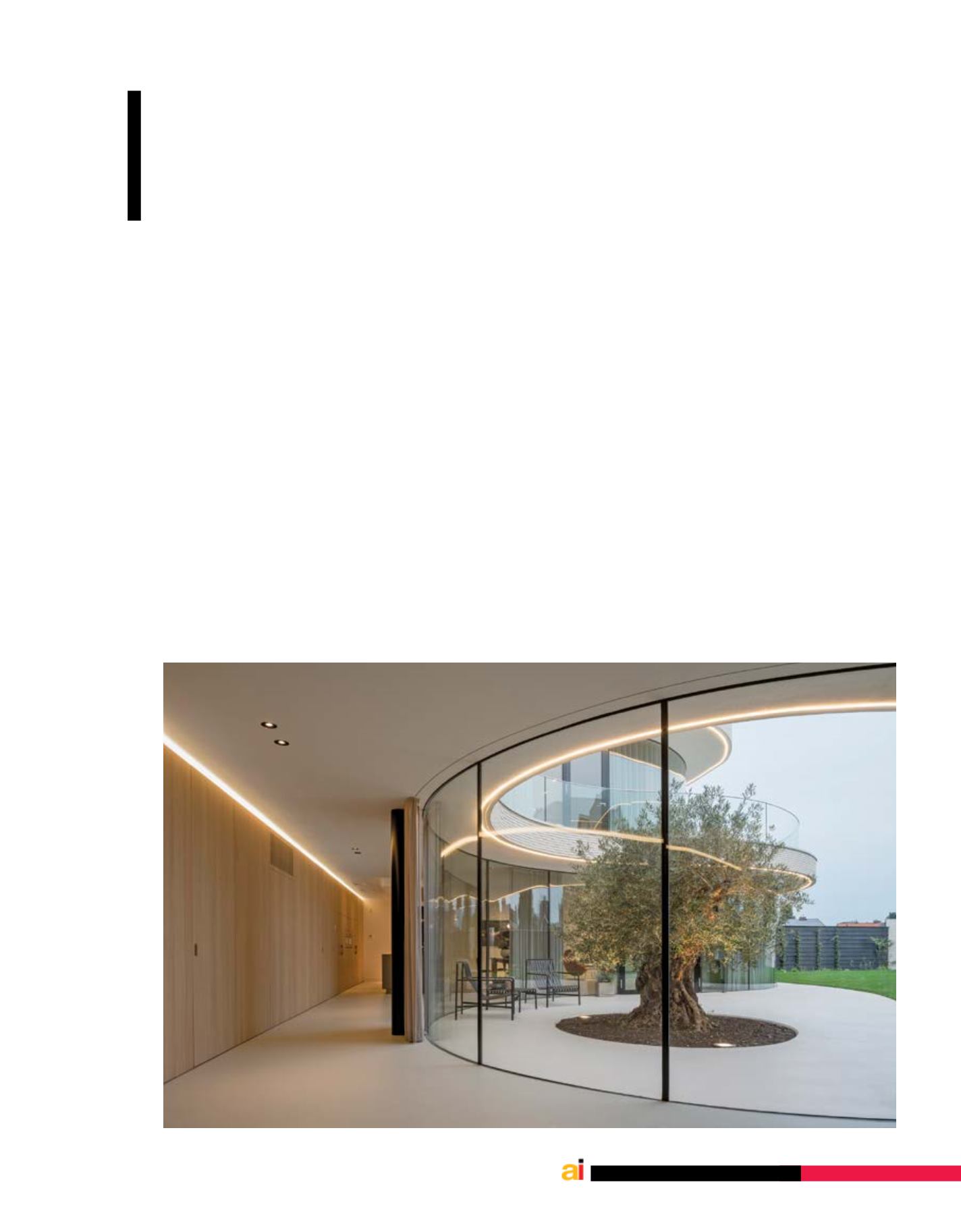
Designed by MVRDV, the 480 sqm. private house was designed to ensure privacy
while maximizing exposure to daylight. Located on the corner plot of an old hospital,
the main facade is made of a rectangular brick wall
;
a mysterious entrance leads to
well lit inner areas defined by a curved, fluid, full height glazed wall. Indented around
an old olive tree, this wall creates a courtyard serving as the focal point of the house.
81
Shira Shenton
Keeping up with MVRDV’s environmental and climate aware
commitment, the living spaces that absorb massive sunlight are slightly
cantilevered for self-shading; a heat pump for percolation, and solar
panels on the root, creating the potential for the house to become self-
sufficient. A sun trap patio provides an extra paved barbecue space for
Dutch summer days.
Serving as the living room’s backbone, a long wood closet conceals all
the domestic functions, including the basement entrance which serves
for extra storage, guest toilet, kitchen cabinets and pantry.
On the upper floor are the bedrooms that open onto a terrace
overlooking the surroundings.
The overall design provides a clean, gimmick-free interpretation of
1930’s modernism, with its long, white brick wall, full-height glazing
and contrasting integration of straight and curved, open and enclosed,
defined and flexible.
Casa Kwantes, Rotterdam,
Netherlands, 2016
MVRDV Architects
Design Team:
Winy Maas, Jacob van Rijs,
Nathalie de Vries, Frans de Witte, Herman
Gaarman, Arjen Ketting and Brygida Zawadzka
Interiors:
DK Projects, BE.
Photos:
Ossip van Duivenbode
.
2016 ,
בית קואנטס, רוטרדם
וויני מאס, ג׳ייקוב ואן רייס, נטלי דה וריס,
:
MVRDV
פראנס דה וויט, הרמן גארמנן, ארין קטינג,
בריגידה זוודג׳קה.
.DK Projects, BE
עיצוב פנים:
.
Ossip van Duivenbode
צילומים:
Casa Kwantes, Rotterdam
gimmick-free interpretation
of 1930s modernism